

Safe Materials for Cat Furniture: A 2026 Guide

Table of Contents
- Why Safe Materials for Cat Furniture Matter
- The Dangers of Formaldehyde in Pet Furniture
- Non-Toxic Cat Tree Materials: A Safe vs Unsafe Comparison
- Best Fabrics for Cat Scratchers and Beds
- Adhesives, Stains, and Finishes: The Hidden Risks
- How to Verify Safety Claims Before You Buy
- Disposal and End-of-Life Safety for Cat Furniture
- Frequently Asked Questions
Last Updated: September 12, 2026
Why Safe Materials for Cat Furniture Matter
Cats spend up to 16 hours a day sleeping and grooming on their furniture, which means they are in constant, close contact with whatever materials make up their trees, beds, and scratchers. Choosing safe materials for cat furniture is not a luxury upgrade; it is a basic health decision. This guide from Blanco's Pet Store walks through exactly which materials are safe, which to avoid, and how to verify a manufacturer's claims before you spend money.
A cat's grooming habit is the real problem. Every time your cat licks its paws after sitting on a treated surface, trace amounts of whatever was on that surface end up ingested. Over months and years, that adds up.
The good news: safe materials for cat furniture are increasingly easy to find, and the difference in cost is usually smaller than owners expect. Below, we break down the specific hazards, the materials worth buying, and a verification checklist you can use in any store or product page.
The Dangers of Formaldehyde in Pet Furniture
Formaldehyde is a colorless gas used in adhesives that bind composite wood, and it is the single most common hidden hazard in budget cat trees. Many composite wood products release formaldehyde and other volatile organic compounds into the air over time, a process known as off-gassing.
The health stakes are real. The Consumer Product Safety Commission has documented formaldehyde as a respiratory irritant, and the Environmental Protection Agency's formaldehyde overview classifies it as a probable human carcinogen at elevated exposure levels. Cats are smaller than humans and breathe closer to the floor, where heavier gases settle.
Signs of off-gassing in a new piece of furniture include a sharp chemical smell, eye or nose irritation in people, and sneezing or watery eyes in cats. If a new cat tree smells strongly of glue or paint, that is your first warning sign.
Non-Toxic Cat Tree Materials: A Safe vs Unsafe Comparison
The safest cat tree materials are solid wood, untreated or water-based-finished, paired with natural fiber coverings. The least safe are particleboard and other composite wood cores wrapped in synthetic carpet, because both the core and the covering can carry chemical treatments.
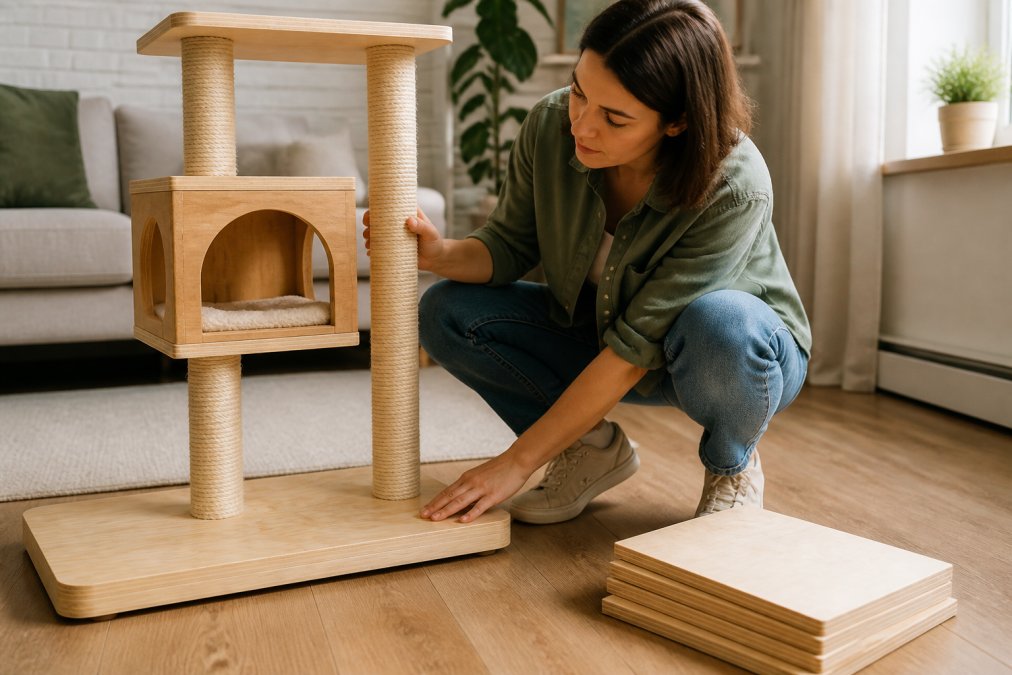
Here is how the most common materials compare:
| Material | Safety Profile | Durability | Notes |
|---|---|---|---|
| Solid hardwood | Low risk | High | No binding adhesives |
| Baltic birch plywood | Low risk | High | Look for low-emissions adhesive |
| Particleboard / MDF | High risk | Low | Formaldehyde binder, crumbles when wet |
| Reclaimed solid wood | Low risk | High | Verify finish is water-based |
| Synthetic carpet wrap | Variable | Medium | Check for stain treatments |
| Sisal rope | Low risk | Medium | Untreated, natural fiber |
| Microfiber | Low risk | Medium | Choose undyed when possible |
Solid hardwood and Baltic birch plywood top the list because they hold their shape without formaldehyde-based binders. Particleboard and medium-density fiberboard are the opposite: cheap, heavy, and glued together with exactly the adhesives you want to avoid.
The mechanism matters more than the label. Particleboard and MDF are engineered by mixing wood fibers or sawdust with a resin binder, most commonly urea-formaldehyde, then pressing the mixture under heat. That binder is what holds the board together, and it is also what releases formaldehyde gas over time. Solid wood has no binder because it is a single piece of timber. Baltic birch plywood sits in between: thin wood plies glued in layers, so the adhesive is the variable to screen. A phenol-formaldehyde binder, common in exterior-grade plywood, releases far less gas than urea-formaldehyde, but a formaldehyde-free adhesive is the safer target.
Synthetic carpet wrap deserves its own warning. The concern is rarely the fiber itself but the backing and the topical treatments. Stain-resistant finishes frequently rely on per- and polyfluoroalkyl substances (PFAS), a chemical class the Environmental Protection Agency has linked to health concerns and is actively studying. Flame retardants are another common additive in imported carpet and foam. Neither belongs against a surface your cat grooms from daily.
Sisal rope is the benchmark scratching surface for a reason: it is a plant fiber, it does not off-gas, and it sheds naturally as your cat scratches. The trade-off is durability. A tightly wound, thick-gauge sisal wrap can last years; a thin, loosely wound wrap can unravel in months, exposing the adhesive underneath. When you inspect a sisal post, press your thumbnail into the wrap, if it gives easily or you can see gaps between coils, it will not hold up.
Best Fabrics for Cat Scratchers and Beds
The best fabrics for cat scratchers and beds are natural fibers with no stain-resistant or flame-retardant treatments. Wool, cotton canvas, and untreated sisal are the standard recommendations. Synthetic dyes and chemical treatments are the two things to screen for, not the fiber type itself.
Sisal rope remains the benchmark scratching surface. It sheds naturally as your cat scratches, it does not off-gas, and it is biodegradable at end of life. The catch is durability: cheap sisal wraps loosen and unravel within months, while tightly wound, thick-gauge rope holds up far longer.
For beds, look for:
- Cotton or wool covers with no "stain guard" label
- Removable, machine-washable covers
- Undyed or naturally dyed fabric for cats with respiratory sensitivity
- No flame-retardant chemicals, which are common in imported foam
Cats with allergies or asthma benefit most from hypoallergenic natural fibers. If your cat sneezes near its bed, the fabric is a reasonable suspect.
Adhesives, Stains, and Finishes: The Hidden Risks
Adhesives, stains, and finishes are where safe materials for cat furniture claims most often fall apart. A solid wood frame means nothing if it is glued with a formaldehyde-based adhesive and sealed with a solvent-based lacquer.
Water-based stain and finish products are the safer choice for any wood furniture your cat touches. They release far fewer VOCs during curing and continue to off-gas at much lower levels afterward. Solvent-based polyurethane and oil-based stains take longer to cure and smell strongly for weeks.
Pet-safe adhesives exist and are worth seeking out: look for low-emissions or formaldehyde-free labeling on the glue itself, not just the wood. Many manufacturers advertise the wood and stay quiet about the adhesive, which is exactly backwards from a safety standpoint.
How to Verify Safety Claims Before You Buy
Verifying safety claims comes down to three things: third-party certification, material disclosure, and your own nose. Marketing language like "eco-friendly" and "natural" is unregulated and means very little on its own.
Start with recognized certifications. UL Solutions GREENGUARD certification program tests products for low chemical emissions, and a GREENGUARD Gold label indicates stricter limits suitable for sensitive environments. California Air Resources Board composite wood standards set some of the strictest formaldehyde limits in the country, so a product compliant with those rules has cleared a meaningful bar. The EPA's Toxic Substances Control Act Title VI rule also sets formaldehyde emission limits for composite wood sold in the United States, which means any domestic or imported product should meet that floor.
Then run this quick checklist:
- Is the wood species named, not just "wood"?
- Is the adhesive described as formaldehyde-free?
- Is the finish water-based?
- Is there a third-party emissions certification?
- Does the product smell neutral out of the box?
If two or more boxes are unchecked, keep looking. If a seller cannot name the wood or the finish, that is your answer.
Testing Furniture You Already Own
Most guides stop at the buying decision, but the furniture already in your home is the harder question. You cannot return a cat tree you bought two years ago, and you may not know what is inside it. A few simple tests can tell you whether it is worth keeping.
The smell test, done properly. Take the piece into a room with no other odors, close the door, and leave it for an hour. Then walk in and breathe normally. A sharp, glue-like, or chemical smell that you notice immediately is a signal. Formaldehyde has a distinctive pungent odor that many people can detect at low levels, though sensitivity varies. If the smell is strong, the piece is still off-gassing.
The warmth test. VOCs release faster when a material is warm. Place the furniture near a sunny window or in a warm room for a few hours, then smell it again. If the odor intensifies noticeably with heat, the material is still actively releasing chemicals. This is a common pattern with composite wood cores.
The moisture test. Wipe a small, inconspicuous area of the wood or composite with a damp cloth. If the surface swells, softens, or the cloth picks up a chalky residue, the core is degrading. Degrading particleboard releases more binder over time, not less.
The scratch test for finishes. On a hidden edge, scratch lightly with a coin. A finish that flakes off in sheets or feels tacky may be a solvent-based lacquer that is still curing. A water-based finish typically feels hard and dry within days of application.
The lead concern for painted or imported pieces. Older painted furniture and some imported items can contain lead in the paint or glaze. Home lead test swabs are widely available at hardware stores and give a rapid color-change result. They are not a substitute for a laboratory test, but a positive swab is a clear reason to remove the piece from your cat's environment.
If a piece fails two or more of these tests, replacement is usually the safer path. The cost of a new solid wood tree is small compared to months of low-level exposure for an animal that sleeps on it sixteen hours a day.
Disposal and End-of-Life Safety for Cat Furniture
End-of-life safety is the angle almost every buying guide skips, and it matters for two reasons: your household's exposure and the environment's. A cat tree that is shedding synthetic carpet fibers or crumbling particleboard is actively releasing material into your home, and it should not be repaired and kept.
Composite wood furniture that has gotten wet is a particular concern. Particleboard swells, breaks down, and can release more of its binder as it degrades. Once a composite cat tree has structural damage or water exposure, replacement is safer than repair.
For disposal:
- Solid wood and untreated sisal can often be composted or recycled
- Synthetic carpet and treated fabrics belong in the trash, not the recycling bin
- Donate intact, clean furniture rather than leaving it curbside, where it degrades
Buying durable construction in the first place is the real fix. A solid hardwood tree that lasts a decade produces one disposal event instead of five.
Finding cat furniture that is genuinely safe takes more than reading a label that says "natural." It takes knowing which materials to trust, which certifications to check, and which questions to ask before you buy. At Blanco's Pet Store, we curate our selection around exactly that standard: carefully selected items for pets and owners, specialized care products, and furniture built to support your cat through every stage of its journey. If you want cat furniture you can feel good about your cat living on, shop the Blanco's Pet Store collection and find pieces chosen with material safety in mind.
Frequently Asked Questions
What materials should I avoid in cat furniture?
Avoid particleboard and composite wood bonded with urea-formaldehyde glues, which can release volatile organic compounds (VOCs) over time. Skip furniture treated with chemical flame retardants, synthetic dyes, or unknown finishes. Treated wood labeled for outdoor use often contains preservatives that are not pet-safe. If a cat tree smells strongly of chemicals when you unpack it, that is a sign of off-gassing and you should return it rather than let your cat use it.
Are formaldehyde-free cat trees safer for cats?
Yes. Formaldehyde is a known respiratory irritant, and cats with respiratory sensitivity or asthma can react to even low levels. Furniture made with solid hardwood, Baltic birch plywood, or explicitly formaldehyde-free adhesives reduces off-gassing risk. Look for low-emissions labels or GREENGUARD certification, which tests for VOC emissions in finished products. A formaldehyde-free cat tree is not just a marketing claim when it carries third-party testing documentation.
What is the best non-toxic fabric for cat scratching posts?
Sisal rope and untreated sisal fabric are top choices because they are natural fibers with no synthetic dyes or chemical treatments. Wool, cotton canvas, and tightly woven microfiber are also good options if they are undyed or colored with water-based, pet-safe dyes. Avoid synthetic carpets treated with stain repellents, which can contain per- and polyfluoroalkyl substances (PFAS). Natural fibers also hold up well to scratching post durability demands.
Is treated wood safe for cat furniture?
Most pressure-treated lumber is not safe for cat furniture because it contains copper compounds and other preservatives cats should not chew or scratch. Heat-treated wood (marked HT) is a safer alternative because it uses temperature rather than chemicals. Untreated solid hardwood, reclaimed wood that has been tested for lead, and Baltic birch plywood with formaldehyde-free adhesive are all better choices for structural integrity and pet safety.
How can I tell if a cat tree is made with toxic glues or dyes?
Check for a chemical smell when you open the box, which indicates off-gassing. Look for GREENGUARD Gold or similar certification on the label. Ask the manufacturer directly what adhesive and dye they use. Water-based stains and pet-safe adhesives are the safest options. If the product has no material disclosure and a strong odor, treat it as a red flag and return it. DIY safety testing kits for formaldehyde are available at hardware stores if you want to verify.
Do safe materials for cat furniture cost more?
Solid hardwood, Baltic birch, and natural fiber fabrics typically cost more than particleboard and synthetic carpet because the raw materials and low-emissions adhesives are more expensive. The trade-off is durability: a well-built solid wood cat tree can last a decade, while a particleboard one may fall apart in a year. Pricing for specific cat furniture depends on the item and current availability, so check the website for current prices.