

Manage Multi-Pet Household Chaos: 7 Proven Steps

Table of Contents
- Step 1: Establish a Consistent Daily Routine
- Step 2: Master Feeding Schedules and Meal Management
- Step 3: Use Crate Training and Physical Boundaries
- Step 4: Preventing Resource Guarding Between Pets
- Step 5: Provide Structured Exercise and Mental Stimulation
- Best Tools for Multi-Pet Management
- How to Introduce a New Pet to the Family
- Common Mistakes to Avoid
- Frequently Asked Questions
Last Updated: October 2, 2026
Step 1: Establish a Consistent Daily Routine
A consistent daily routine is the foundation to manage multi-pet household success. Pets thrive on predictability; when feeding times, play sessions, and quiet periods follow the same schedule, behavioral problems decrease significantly.
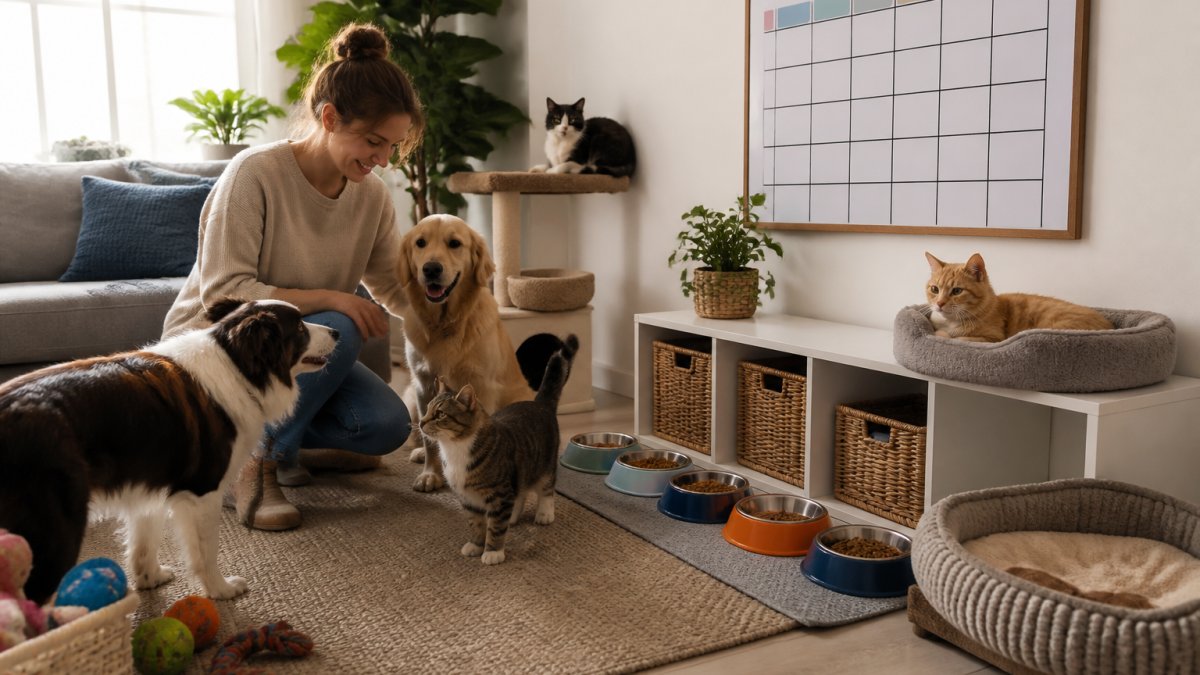
Map out your day in blocks: morning feeding, mid-day exercise, afternoon training, evening wind-down. Write it down and post it where you can see it.
Consistency matters more than perfection. If breakfast happens at 7 a.m., keep it there. Small adjustments are fine, but major deviations trigger anxiety and unwanted behaviors.
Step 2: Master Feeding Schedules and Meal Management
Separate feeding locations are non-negotiable.
Establish feeding protocols: same time, same place, same portion size for each pet. Feed anxious pets away from confident ones to remove conflict triggers and prevent stronger pets from eating weaker pets' food.
Use baby gates to keep pets separated during meals. Wait 15 minutes after feeding before allowing access to other areas. This teaches impulse control and prevents food-related aggression.
| Feeding Protocol Element | Purpose | Implementation |
|---|---|---|
| Separate locations | Prevents resource guarding | Different rooms or gated areas |
| Consistent timing | Reduces anxiety and unpredictability | Same time daily |
| Individual portions | Ensures proper nutrition for each pet | Measured servings per pet |
| Post-meal separation | Prevents food theft and conflict | 15-minute isolation after eating |
Track what each pet eats. Shared feeding spaces hide weight loss and appetite changes until they become serious.
Step 3: Use Crate Training and Physical Boundaries
Crate training is a management tool that creates safe spaces and prevents conflict. In a multi-pet household, crates let you manage who has access to what space and when.
Setting Up Crates for Safety and Comfort
Each pet needs their own crate sized large enough to stand, turn around, and lie down, but small enough to feel secure. Place crates in different rooms to prevent visual conflict and territorial behavior.
Introduce crates gradually. Leave the door open, toss treats in, and let them explore. Once your pet enters willingly, close the door briefly while nearby, gradually extending the time to build positive associations.
Use crates during high-risk times: when you can't supervise, during meals, when introducing new pets, or during medical rest.
Baby Gates and Tethering Strategies
Baby gates divide your home into zones, preventing constant interaction and reducing resource guarding triggers. A gate between the living room and kitchen keeps your dog out of the cat's feeding area.
Tethering (attaching a leash to a stationary object) works for short periods to manage one pet's movement. Tether your high-energy dog during meal times to prevent harassment of other pets.
Never tether for extended periods. Combine it with crate training and gates for comprehensive household management.
Step 4: Preventing Resource Guarding Between Pets
Resource guarding, when a pet becomes defensive over food, toys, or territory, escalates quickly in multi-pet homes. Prevention is infinitely easier than correction.
To manage multi-pet household dynamics, never allow pets to compete for resources. Separate feeding locations eliminate food-related guarding; separate toy boxes prevent toy-related conflict; separate sleeping areas prevent territorial behavior.
If guarding behavior emerges, remove the trigger immediately. Feed separately, store toys individually, and create physical boundaries with gates and crates.
Reward calm behavior around resources. If your dog relaxes when another pet approaches their toy, praise and treat. Consistency produces results.
Step 5: Provide Structured Exercise and Mental Stimulation
A tired pet is a well-behaved pet. Exercise reduces stress and prevents destructive behavior. In multi-pet households, exercise needs vary dramatically, meet each pet's needs individually.
Create an exercise schedule accounting for age, health, and temperament. Walk your dog separately to provide focused attention and prevent resource guarding over your attention.
Mental stimulation matters as much as physical exercise. Puzzle feeders, sniff games, and training sessions reduce behavioral problems and resource guarding.
Rotate toys and activities to maintain engagement and prevent boredom-driven aggression.
Best Tools for Multi-Pet Management
Blanco's Pet Store offers a carefully curated selection of pet essentials, ranging from everyday necessities and engaging toys to specialized care products. We are dedicated to supporting pets and the people who love them by providing high-quality items that promote comfort, health, and joy. Whether you are looking for training tools, cozy bedding, or stylish accessories, our store is here to help you and your pet enjoy every moment together.
How to Introduce a New Pet to the Family
Adding a pet to an established household requires patience and structure. Rushed introductions create lasting conflict. Slow introductions build positive associations. However, the introduction process differs dramatically depending on which species you're combining, dog-to-dog introductions follow different rules than cat-to-dog, and small animals require entirely separate protocols.
The 3-3-3 Rule for Pet Integration
The 3-3-3 rule provides a realistic timeline: three days of adjustment to a new environment, three weeks to begin settling in, three months to truly integrate.
Days 1-3: Confine the new pet to a single room with food, water, litter box (if applicable), and bedding. Let existing pets smell under the door.
Weeks 1-3: Introduce visual contact through a baby gate. Feed on opposite sides of the gate.
Months 1-3: Supervised time together in shared spaces. Keep sessions short, 15-20 minutes. Separate them afterward. Gradually extend the duration. Watch for resource guarding, territorial behavior, and stress signals.
Multi-Species Integration: Cat-to-Dog Households
Introducing a cat to a dog household (or vice versa) requires species-specific awareness. Dogs are predatory; cats are prey animals. This fundamental difference shapes every interaction.
Pre-introduction assessment: Before bringing a cat into a dog home, honestly evaluate your dog's prey drive.
Scent introduction (Days 1-7): Swap bedding between the cat's room and the dog's space.
Visual introduction through barriers (Weeks 1-2): Use a baby gate or cracked door so they can see each other without contact.
Controlled supervised contact (Weeks 2-4): Allow brief, leashed contact in a neutral space (not the cat's room or the dog's primary territory).
Multi-Species Integration: Small Animals (Rabbits, Guinea Pigs, Hamsters) with Dogs or Cats
Small animals are prey. Both dogs and cats have predatory instincts. Integration is often not feasible, and permanent separation is the safest approach.
Assessment before adoption: If you own a dog or cat with high prey drive, reconsider adding a small animal.
If cohabitation is necessary: Small animals must have a secure enclosure that neither dogs nor cats can access, tip over, or break into. This is not a temporary management tool, it's permanent housing.
Scent introduction only: Unlike dogs and cats, small animals do not benefit from gradual visual or physical introduction.
Managing Individual vs. Group Training Sessions
Train each pet individually first. This prevents competition for your attention and lets you focus on one animal's needs. Once each pet understands basic commands, introduce group sessions cautiously.
Group training builds impulse control and teaches pets to focus on you despite distractions. Start with simple commands in a neutral space. Reward heavily for calm behavior around the other pet. Keep sessions short, 5-10 minutes max.
Some pets will never be comfortable training together. That's fine. Individual training sessions remain the primary approach.
Common Mistakes to Avoid
Assuming all pets have the same needs is the first major mistake. Your senior cat needs quiet rest; your young dog needs intense exercise.
Skipping the routine phase is another critical error. Owners often think they can manage chaos through training alone. Routine creates the foundation.
Allowing unsupervised interaction too early causes lasting problems.
Neglecting individual attention is common in multi-pet homes. Each pet needs one-on-one time with you.
Finally, giving up too soon derails progress. Multi-pet household management takes months, not weeks. Consistency matters more than perfection. Small improvements compound.
Frequently Asked Questions
What is the 3-3-3 rule for introducing new pets to a multi-pet household?
The 3-3-3 rule is a timeline for pet integration: 3 days to decompress, 3 weeks to adjust, and 3 months to fully bond. During the first 3 days, keep the new pet separate in a quiet space. After 3 weeks, they should be comfortable in shared areas with supervision. By 3 months, most pets establish their place in the household hierarchy. This gradual approach prevents stress, resource guarding, and behavioral conflicts.
How do you prevent resource guarding in a multi-pet home?
Feed pets in separate rooms or use baby gates to create physical distance during meals. Remove high-value toys when pets are together and rotate them instead. Practice positive reinforcement training to teach 'leave it' and 'drop it' commands. Supervise all interactions closely and redirect any tension immediately. Provide each pet with their own water bowl, bed, and toys in different areas. Consistency and boundaries are key to preventing territorial behavior and conflict.
What are the best tools for managing multiple pets in one household?
Essential tools for managing multiple pets include items that help create safe confinement, section off areas, provide close supervision, and facilitate separate feeding. Interactive toys and puzzle feeders can provide mental stimulation that reduces stress and destructive behavior. Training tools help with individual attention and command practice. Calming aids can support pets struggling with multi-pet stress. Quality bedding and comfortable spaces give each pet their own retreat area away from others.
How can I give each pet individual attention in a multi-pet household?
Schedule one-on-one time with each pet daily, even if just 10-15 minutes. Use separate rooms or rotate outdoor time so each gets undivided attention. Individual training sessions build confidence and strengthen your bond. This prevents jealousy, reduces separation anxiety, and allows you to address each pet's unique needs, whether that's extra exercise for a high-energy dog or quiet time for a senior cat. Consistency signals to each pet that they matter individually.
Managing a multi-pet household requires structure, patience, and the right tools. Blanco's Pet Store helps you create that structure with carefully selected products designed for multi-pet homes, from durable gates and quality crates to specialized feeders and training equipment. Shop our collection and turn household chaos into calm, organized coexistence.