

Interactive Toys for Bored Indoor Cats: Top Picks

Table of Contents
- Why Interactive Cat Toys Matter for Bored Indoor Cats
- Quick Comparison: Interactive Cat Toys at a Glance
-
Best Interactive Cat Toys for Bored Indoor Cats
- Rechargeable Motion-Activated Fish Toy
- Rechargeable Automatic Rolling Ball Toy
- Interactive Rolling Cat Toy, Ball, Cover & Set Options
- Cat Feather Teaser Toy with Suction-Cup Options
- Cat Teaser Toy
- Wind-Up Mouse Toys for Cats, 3-Pack
- Plastic Spring Toys for Cats
- Sisal Ball Toy for Cats
- Mouse Toy for Cats
- Toys for Cats That Play Alone: Solo Enrichment Solutions
- Cat Puzzle Toys: Mental Stimulation for Bored Cats
- How to Keep an Indoor Cat Entertained: A Daily Play Routine
- How Much Playtime Does an Indoor Cat Need?
- Safety, Durability, and Supervision Guidelines
- Frequently Asked Questions
Last Updated: October 18, 2026
Why Interactive Cat Toys Matter for Bored Indoor Cats
A bored indoor cat has nowhere to direct natural hunting instincts, and that energy has to go somewhere, which is why interactive toys for bored indoor cats matter so much. Interactive toys for bored indoor cats give that energy a target: something to stalk, chase, and pounce on instead of the curtains.
Indoor cats live longer, safer lives than outdoor cats, but they trade variety for routine. The American Association of Feline Practitioners' indoor cat guidance recommends daily play and environmental enrichment as part of routine feline care. Play is not a luxury for these cats. It is how they exercise, relieve stress, and stay mentally engaged.
Below, we walk through the toy types that actually hold a cat's attention, with prices, a comparison table, and a simple daily routine you can copy.
Quick Comparison: Interactive Cat Toys at a Glance
Here is the full lineup side by side. Every toy below is in stock at Blanco's Pet Store, and prices are current as of October 2026.
| Toy | Price | Play Style | Best For |
|---|---|---|---|
| Motion-Activated Fish | $6.99 | Solo, motion-triggered | Cats that bat at still objects |
| Automatic Rolling Ball | $8.99 | Solo, self-rolling | High-energy chasers |
| Interactive Rolling Toy Set | $13.99 | Solo or paired | Multi-cat homes |
| Feather Teaser with Suction Cup | $4.99 | Solo or interactive | Hands-free play |
| Cat Teaser Toy | $4.99 | Interactive, hands-on | Bonding sessions |
| Wind-Up Mouse 3-Pack | $6.99 | Solo, wind-up motion | Cats that like small prey |
| Plastic Spring Toys | $2.99 | Solo, unpredictable bounce | Kittens and playful adults |
| Sisal Ball Toy | $4.99 | Solo, rolling | Cats that like texture |
| Cat Puzzle Toy | $5.99 | Solo, food-based | Food-motivated cats |
Best Interactive Cat Toys for Bored Indoor Cats
Every pick below earns its place for a different reason. We grouped them by play style so you can match a toy to your cat, not the other way around.

Rechargeable Motion-Activated Fish Toy
This is the pick for cats that ignore toys until something moves. The fish responds to a tap or shake, wiggles for a short burst, then pauses until triggered again. It measures about 30 cm, charges by USB in roughly 40 minutes, and runs about 20 minutes per charge.
Price: $6.99.
Rechargeable Automatic Rolling Ball Toy
High-energy cats get a moving target that keeps rolling without you. The ball is made of PC and silicone and charges by USB Type-C. Appearance and attachments vary by option, so check the listing before ordering.
Price: $8.99.
Interactive Rolling Cat Toy, Ball, Cover & Set Options
This is the most flexible option in the lineup. Choose balls, rope-style designs, cover-and-ball combinations, or full sets. Note that the "Only Cover" option is the cover alone, without a ball.
Price: $13.99. Best for multi-cat homes where different cats prefer different textures.
Cat Feather Teaser Toy with Suction-Cup Options
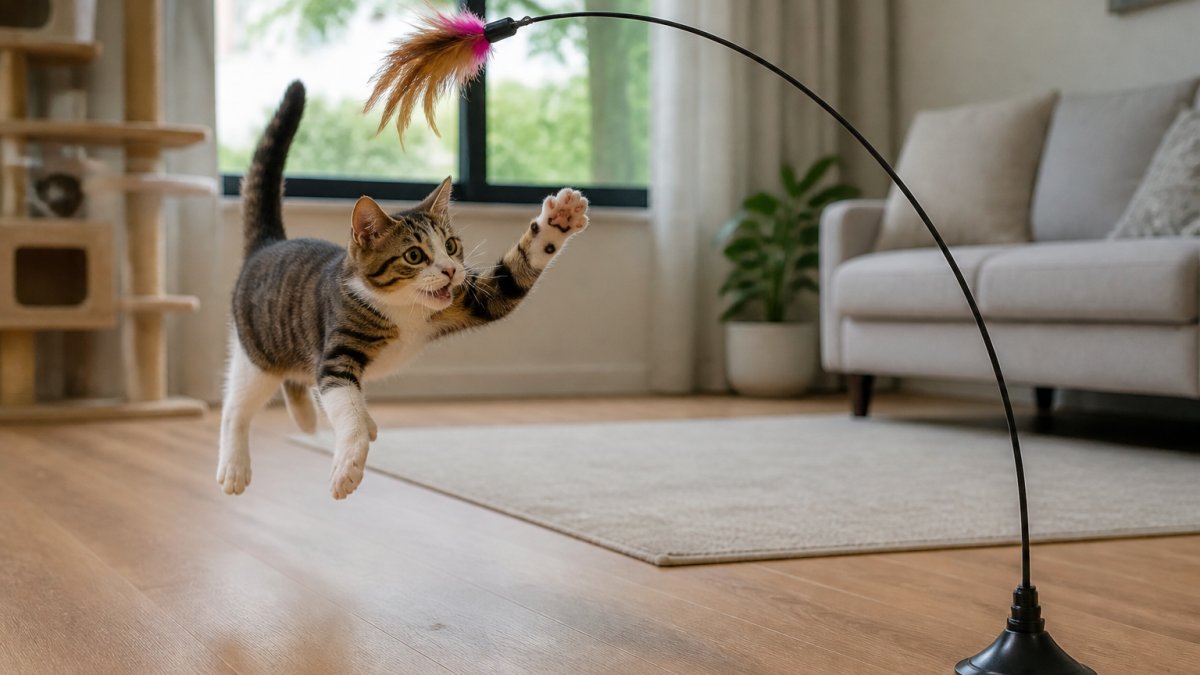
Feather wands satisfy the stalk-and-pounce instinct better than anything else. The suction-cup base lets the wand move hands-free, so your cat gets solo play between your sessions.
Price: $4.99.
Cat Teaser Toy
A straightforward feather-style teaser in black, white, or pink, each offered as Normal or Enhanced. The difference between the two options is not specified, so pick on color if that matters to you.
Price: $4.99. Best for short, hands-on bonding sessions.
Wind-Up Mouse Toys for Cats, 3-Pack
Wind-up mice give cats a small, erratic target that mimics prey. Three to a pack means one can be "lost" under the couch without ending playtime.
Price: $6.99. Moving parts need supervision, so put these away after play.
Plastic Spring Toys for Cats
Springs bounce unpredictably, which is exactly why cats love them. Available in packs of 4, 8, 16, or 20.
Price: from $2.99. The cheapest way to test whether your cat likes solo play at all.
Sisal Ball Toy for Cats
A textured sisal ball in seven colors. Roll it nearby and let your cat explore at their own pace. Dental-cleaning benefits have not been verified, so buy it for play, not for teeth.
Price: $4.99.
Mouse Toy for Cats
A simple mouse-shaped toy in plastic and plush. The supplier does not specify whether it moves, so treat it as a bat-and-carry toy rather than a self-propelled one.
Price: $3.99.
Toys for Cats That Play Alone: Solo Enrichment Solutions
Toys for cats that play alone work best when they move without you. The motion-activated fish, automatic rolling ball, and wind-up mice all fit that brief: set them down, and the toy does the work.
Rechargeable Motion-Activated Fish Toy for Cats →

The catch is that solo toys lose novelty fast. Rotate three or four toys weekly, keeping the rest out of sight, and each one feels new when it returns. A common mistake is leaving every toy on the floor at once. Cats habituate to clutter and stop noticing it.
Cat Puzzle Toys: Mental Stimulation for Bored Cats
Puzzle toys replace physical chasing with problem-solving, which matters most for cats that cannot run and jump: seniors with arthritis, cats recovering from injury, and cats on activity restriction. They also give food-motivated cats a job to do instead of a bowl to stare at.
A puzzle toy works by putting food behind a barrier the cat has to move, paw, or nose aside.

Puzzle difficulty should climb in steps, not jump. A common pattern is to rotate among three puzzles: one the cat can solve instantly, one that takes a little work, and one that is genuinely hard. The easy one rebuilds confidence after a failed attempt on the hard one.
Food-based enrichment does not require a purchase. A muffin tin with treats in a few cups and tennis balls over the rest is a classic DIY puzzle. A cardboard box with paper crumpled around kibble works the same way.
Know which cat you have before you buy. A food-motivated cat will work a puzzle for ten minutes; a cat that ignores treats will walk away. For the second cat, a puzzle with a toy or feather inside, rather than food, is the better fit.
Safety note: check puzzle parts weekly for cracks and loose pieces, and retire any puzzle with a piece small enough to swallow. Supervise the first few sessions with any new puzzle, especially for cats that chew.
How to Keep an Indoor Cat Entertained: A Daily Play Routine
Keeping an indoor cat entertained comes down to rhythm, not volume. Two short sessions beat one long one, and a predictable routine gives your cat something to anticipate.
- Morning (5-10 minutes): Wand or teaser session before feeding. End with a successful catch.
- Midday: Set out one solo toy, such as the rolling ball or fish.
- Evening (10-15 minutes): Second wand session, then a puzzle toy with dinner.
- Weekly: Rotate solo toys and swap in a different texture.
Finish every session with a meal or treat. That sequence mimics the hunt-eat-groom-sleep cycle cats follow in the wild, and it settles them.
Ohio State University's indoor pet enrichment guidance notes that play sessions should end with the cat catching the toy, which builds confidence and keeps the game rewarding.
How Much Playtime Does an Indoor Cat Need?
Most indoor cats need two to three play sessions a day, totaling roughly 20 to 30 minutes. Kittens and high-energy breeds often want more; senior cats with arthritis may manage five-minute bursts. Those numbers are a starting point, not a prescription.
Watch for observable signals rather than counting minutes. A session is productive when the cat tracks the toy with its eyes, crouches before a pounce, and stays with the game for more than a minute or two.
Track three things over a week: how long the cat stays engaged per session, whether the cat initiates play by returning to the toy or the play area, and whether the cat's interest holds across days.
Age and mobility change the plan. For a kitten, short frequent sessions with a wand and spring toys build coordination; expect five to ten minutes, four or five times a day.
Play style matters as much as age. A cat that stalks prefers a wand dragged behind furniture; a cat that chases prefers a ball or a rolling toy; a cat that pounces prefers a toy that pops out from a hiding spot.
A structured routine beats a single purchase. Morning wand session before feeding, one solo toy midday, evening wand session followed by a puzzle with dinner, and a weekly toy rotation covers exercise, mental stimulation, and solo engagement without requiring a new purchase every month.
Safety, Durability, and Supervision Guidelines
Supervise play with anything that has moving parts, strings, or small pieces. That includes wind-up mice, wand toys, and rechargeable toys. Put them away afterward rather than leaving them on the floor.
Check toys weekly for cracks, loose attachments, or exposed batteries, and remove anything damaged. Never use a rechargeable toy while it is charging. For cats that chew, feather and string toys are the highest-risk category, so keep sessions short and hands-on.
Frequently Asked Questions
What are the best interactive cat toys for cats that play alone?
For solo play, automatic and motion-activated toys work best. The Rechargeable Motion-Activated Fish Toy ($6.99) responds to taps or shakes and runs for about 20 minutes per charge. The Rechargeable Automatic Rolling Ball Toy ($8.99) offers a moving target with USB Type-C charging. Both give your cat a self-directed outlet for chasing and pouncing without you holding a wand. Rotate them with puzzle toys to prevent habituation.
How often should I rotate my cat's toys?
Rotate toys every few days to keep them novel. Cats lose interest in familiar objects quickly, so swapping out two or three toys at a time can renew engagement. Keep a small stash hidden and bring it back after a week. Pair rotation with a structured play session using a wand toy, then leave a puzzle toy or automatic ball out for solo enrichment. This cycle maintains mental stimulation without buying new items constantly.
Are cat puzzle toys good for indoor cats?
Yes. Cat puzzle toys provide mental stimulation and tap into natural foraging instincts. The Cat Puzzle Toy ($5.99) comes in round or square suede options and encourages your cat to work for treats or kibble. Puzzle toys are especially useful for bored indoor cats that need more than physical exercise. Start with an easy puzzle and increase difficulty as your cat learns. Always supervise initial sessions and check for loose pieces.
How much playtime does an indoor cat need each day?
Most indoor cats benefit from two to three interactive play sessions daily, totaling 15 to 30 minutes. Short, frequent sessions mimic natural hunting bursts better than one long session. Use a wand toy for active chasing, then reward with a small treat or meal. Solo toys like the automatic rolling ball can fill gaps during the day, but they do not replace hands-on play. Adjust based on your cat's age, mobility, and energy level.
A bored indoor cat is not a lost cause; it is a cat waiting for the right target. If you are not sure where to start, our team at Blanco's Pet Store can help you match a toy to your cat's age, energy level, and play style, from a $2.99 spring pack to a $13.99 rolling set. Every order ships with our curated quality check and a return policy that covers toys that do not hold up. Shop now and give your cat something worth chasing.