

How to Measure a Dog for a Mobility Harness

Table of Contents
- Tools You Need Before You Start Measuring
- How to Measure Dog Girth for a Harness
- Neck Circumference and Back Length: The Supporting Numbers
- Measuring a Dog With Mobility Limitations
- Reading a Dog Harness Size Chart
- How to Fit a Dog Support Harness
- Service Dog Mobility Harness Fit and Safe Use
- Frequently Asked Questions
Last Updated: October 20, 2026
Tools You Need Before You Start Measuring
The best tool for measuring a dog for a mobility harness is a flexible cloth tape measure. A metal tape will not bend around a ribcage, it slips, startles the dog, and gives an untrustworthy number.
Here is what to gather before you touch the dog:
- Flexible tape measure (cloth or vinyl, 60 inches is plenty for most dogs)
- A helper if your dog cannot stand still on their own
- Treats for rewards and slow, calm handling
It is easier than it looks, about five minutes once the dog is relaxed.
Using String or Ribbon When You Don't Have a Flexible Tape
No cloth tape? Use string, ribbon, or a long shoelace. Wrap it around the dog, pinch where the end meets the start, then lay it flat and measure that length with any straight ruler.
Mark the pinch point with a pen before you let go, a slipped mark means starting over.
How to Measure Dog Girth for a Harness
Chest girth is the number that matters most when you measure a dog for a mobility harness: the full distance around the widest part of the ribcage, just behind the front legs.
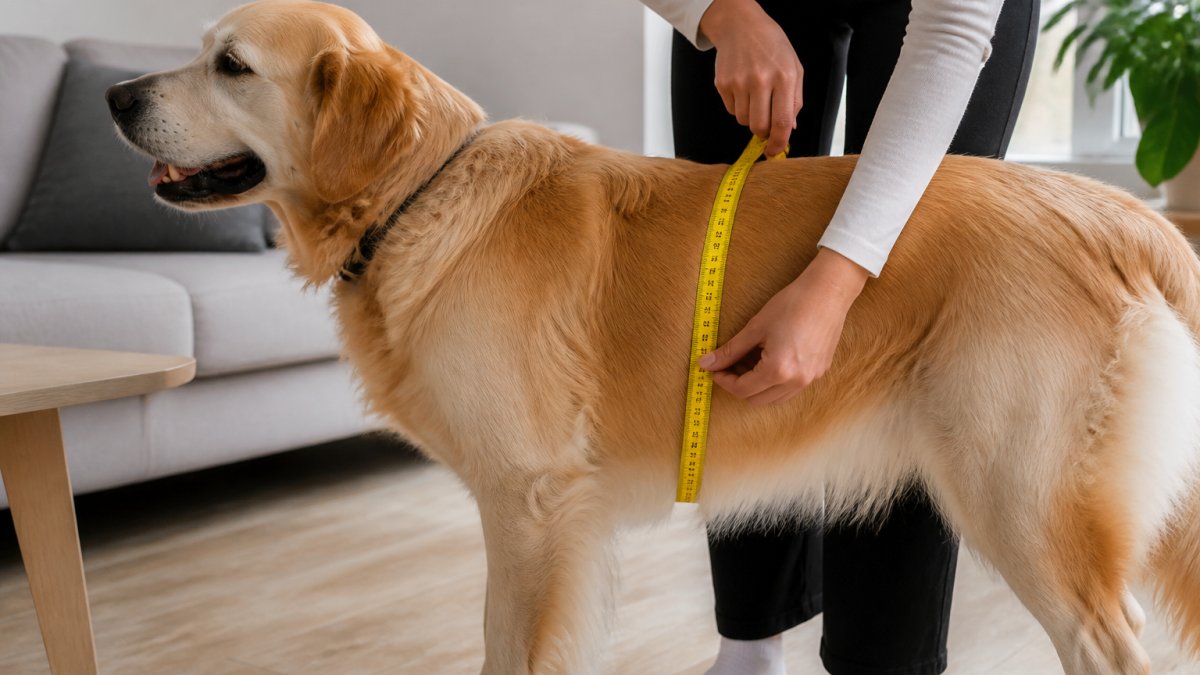
Follow these steps:
- Have the dog stand squarely on all four feet, not sit.
- Find the widest point of the ribcage, usually right behind the front legs.
- Wrap the flexible tape around that point, all the way around the body.
- Keep the tape snug against the coat but not tight enough to press into the skin.
- Read the number where the tape meets itself.
- Write it down immediately.
A common mistake is measuring over a thick winter coat and fitting the harness in summer. A heavy coat can add real inches. Measure the dog the way they will actually wear the harness.
Converting a String Measurement With a Ruler
Lay the marked string straight against a ruler on a hard floor, pressed flat so it does not bow. Read from the start to your pen mark; if the ruler is shorter than the string, measure in two passes and add the numbers.
Do this twice; if the readings differ, take a third and use the middle number.
Neck Circumference and Back Length: The Supporting Numbers
Neck circumference and back length are secondary numbers. Chest girth decides the size.
Measure the neck where a collar naturally rests, not up behind the ears. Keep the tape snug but able to slide one finger underneath.
For back length, measure from the base of the neck, between the shoulder blades, to the base of the tail.
The withers are the highest point of the shoulders.
Measuring a Dog With Mobility Limitations
A dog with weak hind legs, arthritis, or balance problems cannot always stand for five minutes. You adapt the process, not the number.
Set Up Before You Touch the Dog
Preparation is most of the job with a mobility-limited dog. Do these first so measuring takes under a minute:
- Non-slip footing. A yoga mat, rubber-backed rug, or bath mat under the dog's feet. An unsteady dog fights the tape and gives a loose reading.
- A helper who knows the plan. Decide who holds the dog and who measures before you start.
- Treats within reach. Soft treats the dog can swallow quickly, so rewards do not break the stance.
Supported Standing Position
If the dog can stand but not for long, have the helper support from underneath rather than from the harness: one hand under the chest, one under the belly or hips, palms up, lifting just enough to take the wobble out.
With the dog supported, take chest girth first, because it picks the size. Wrap the tape around the widest part of the ribcage, just behind the front legs, and keep it level, parallel to the floor, not tilted toward the shoulders or hips.
Measuring a Recumbent Dog
A dog who cannot stand at all can still be measured accurately. Lay the dog on their side on a non-slip surface, helper keeping the spine straight and legs relaxed.
A recumbent dog's ribcage spreads under its own weight, so take the reading twice: once lying naturally and once with the helper gently supporting the belly to approximate a standing shape.
Take Each Measurement Two or Three Times
Dogs with limited mobility shift their weight, and a shifted dog gives a shifted number. Repeat until two readings match within a half inch. If three in a row disagree, the dog is not settled, rest, reward, and start again rather than averaging bad numbers.
When to Remeasure
A mobility-limited dog's body changes faster than a healthy dog's, and a harness that fit last season may not fit now. Remeasure chest girth:
Dog Lift Harness,for Assistance →
- Every 4 to 6 weeks while recovering from injury or surgery.
- Every 2 to 3 months for a progressive condition, or any dog whose weight or muscle tone is changing.
- Any time the harness starts rubbing, rotating, or needing a different strap setting. A fit change is often the first sign the dog's body has changed.
Reading a Dog Harness Size Chart
A dog harness size chart lists sizes by chest girth range, not by breed or weight. Two dogs at the same weight can have very different ribcages.

Read the chart like this:
| What the chart lists | What you do with it |
|---|---|
| Chest girth range (e.g. 22-27 in) | Match your girth number to the range it falls inside |
| Neck range | Confirm your neck number fits the same size |
| Back length | Check only if the harness uses a back plate |
| Weight guide | Treat as a rough cross-check, never the deciding number |
If your girth number lands at the very top of one range, size up. A harness that is slightly too large can be adjusted down with the straps. One that is too small cannot be adjusted up.
How to Fit a Dog Support Harness
Fitting is where a correct measurement becomes a harness that actually helps. Put it on, then check three things before you take the dog anywhere.
Check the chest strap. It should sit behind the front legs, flat against the body.
Check the neck strap. Same two-finger rule. If it rides up toward the throat, the chest strap is too loose.
Static Fit Checks Before Movement
Do these with the dog standing square and relaxed, before any load goes on the handle:
- Slide two fingers under the chest strap at its tightest point. Three means too loose and the harness will rotate when you lift; zero means it will rub.
- Run a flat hand under the neck strap and along the chest plate. Any edge that curls or digs is a pressure point waiting to become a sore.
- Check every adjustable strap is threaded through its buckle and locked, not half-threaded. A strap that slips under load turns a support harness into a hazard.
Fit Checks During Movement
A harness that passes a standing check can still fail the moment the dog walks. Walk the dog on a loose leash for 30 to 60 seconds and watch for these four signals:

- Rubbing under the front legs. Look for red skin, flattened fur, or the dog slowing and licking at the armpit. This is the most common fit failure on a mobility harness because the chest strap sits exactly where the leg swings.
- Harness rotation. The chest plate should stay centered on the sternum. If it drifts to one side as the dog trots, the girth is too loose or the straps are uneven.
- Restricted gait. Watch the front legs from the side. A too-tight chest strap shortens the forward reach; a too-low chest plate catches the elbow. The dog should stride out the same as they do without the harness.
- Shifting at the shoulders. Grab the handle lightly and rock it side to side while the dog stands. The harness should move with the dog's body, not slide across the coat. Sliding means the girth reading was taken too loose.
Fit Checks Under Load
This is the step most owners skip, and it matters most on a mobility harness. With the dog standing on a non-slip surface, apply light, steady upward pressure on the handle, the same amount you would use to help the dog rise.
Then do a longer motion check: walk the dog a few steps, watch for rubbing under the front legs, and adjust the adjustable straps one notch at a time.
Our Dog Lift Harness for Assistance at $33.99 is built for exactly this kind of check, with a handle positioned for steady lifting support. For dogs who need help at the back end rather than the front, the Dog Hind Leg Support Harness at $25.99 targets the hips and rear legs.

Service Dog Mobility Harness Fit and Safe Use
A service dog mobility harness carries more load than a walking harness, so the same girth number applies but the checks are stricter.
Run through this list before any load goes on the handle:
- Chest strap sits flat behind the front legs with two fingers of slack
- Neck strap does not press on the throat
- All adjustable straps are locked, not half-threaded
Then check fit under load: with light, steady pressure on the handle, watch whether the chest strap digs in or the harness slides sideways. If it does, stop and readjust before using it for real support.
A few safety rules owners often skip:
- Never lift a dog fully off the ground by the handle unless the harness is designed for it.
- Never use the handle to drag a reluctant dog.
- Check the straps for wear every few weeks, especially on a dog who wears the harness daily.
For everyday walks and training between mobility sessions, a lighter option like our Reflective No Pull Dog Harness at $9.99 keeps the pressure off the neck, and the Quick Release Pet Harness at $6.99 is easy to put on a dog who dislikes being handled.
Dogs change shape as they age or gain and lose weight. For more on caring for aging pets, the ASPCA's pet care guidance covers senior dog health basics, and the AVMA's resources on mobility and arthritis in dogs explains what mobility support can and cannot do. The FDA's guidance on pet products and safety is worth a read if you have questions about product claims.
Frequently Asked Questions
How do I measure my dog's girth for a harness?
Wrap a flexible tape measure around the widest part of your dog's ribcage, just behind the front legs. Keep the tape flat against the coat and snug, not tight. Write the number down in inches. If your dog has a heavy coat, add about half an inch so the harness isn't pressing into the fur. Repeat the measurement twice to check accuracy, since a wiggly dog can shift the tape and throw off the number by an inch or more.
Can I use my dog's weight to pick a mobility harness size?
Weight alone is not reliable. Two dogs at 50 pounds can have very different chest girths depending on breed, build, and coat thickness. Always confirm with a tape measurement. Use weight only as a starting guess when you look at a dog harness size chart, then verify against the girth number. If the chart lists a weight range and a girth range that point to different sizes, go with the girth measurement.
How tight should a mobility harness fit on my dog?
You should be able to slide two flat fingers under every strap. The harness needs to stay put when you lift with the support handle, so a little snugness at the chest strap is fine, but it should never dig in or leave red marks. Watch your dog walk, sit, and lie down after fitting. Straps that gap open during movement are too loose, and straps that bunch the fur or restrict the shoulder are too tight.
What should I do if my dog is between mobility harness sizes?
Size up when your dog's girth lands within half an inch of the top of a range, especially for a mobility harness where straps need room to adjust. A harness that is slightly large can be tightened, but one that is too small cannot be stretched. Check that the larger size still has enough adjustment at the neck strap and chest strap to sit flat. Re-measure after any weight change of a few pounds.
Measuring for a mobility harness comes down to one number: chest girth, taken with a soft tape on a calm, standing dog. Everything else confirms it. If your dog is slowing down or struggling on walks, the right harness makes daily life easier for both of you. Blanco's Pet Store carries carefully selected mobility and support gear for pets at every stage, including lift harnesses, hind leg support, and everyday walking harnesses. Shop now and get your dog the support they deserve.