

How to Choose Durable Pet Beds: 2026 Buying Guide

Table of Contents
- Start With Your Dog's Destruction Style, Not the Fabric
- Chew-Proof Dog Bed Materials: What Actually Holds Up
- Pet Bed Size Guide: Measuring Nose to Tail
- Support Materials That Keep Their Shape
- How to Clean Durable Pet Beds Without Breaking Them Down
- Repairability, Replacement Parts, and Weight-Bearing Limits
- Frequently Asked Questions
Last Updated: September 17, 2026
Start With Your Dog's Destruction Style, Not the Fabric
Most buyers start with fabric swatches. That's backwards. The dogs who wreck beds fastest aren't defeated by thicker material; they're defeated by a bed that ignores how the dog actually behaves. Learning how to choose durable pet beds begins with one question: what does your dog do to a bed in the first 48 hours? We've watched this pattern play out across many pet households, and the answer changes every material recommendation that follows.
Nesters, Diggers, Chewers, and Leakers
Dogs damage beds in four recognizable ways, and each one demands a different fix.
- Nesters circle and paw before lying down. They compress filling and split seams over time.
- Diggers scratch at the surface to "make a spot." They shred covers from the top down.
- Chewers target zippers, corners, and tags. They destroy a bed from the seams inward.
- Leakers, including seniors and puppies in training, saturate fabric and break down filling from moisture.
Chew-Proof Dog Bed Materials: What Actually Holds Up
Durability comes down to three measurable things: fabric denier, weave type, and construction at the seams. Ignore the marketing adjectives and read the spec sheet.
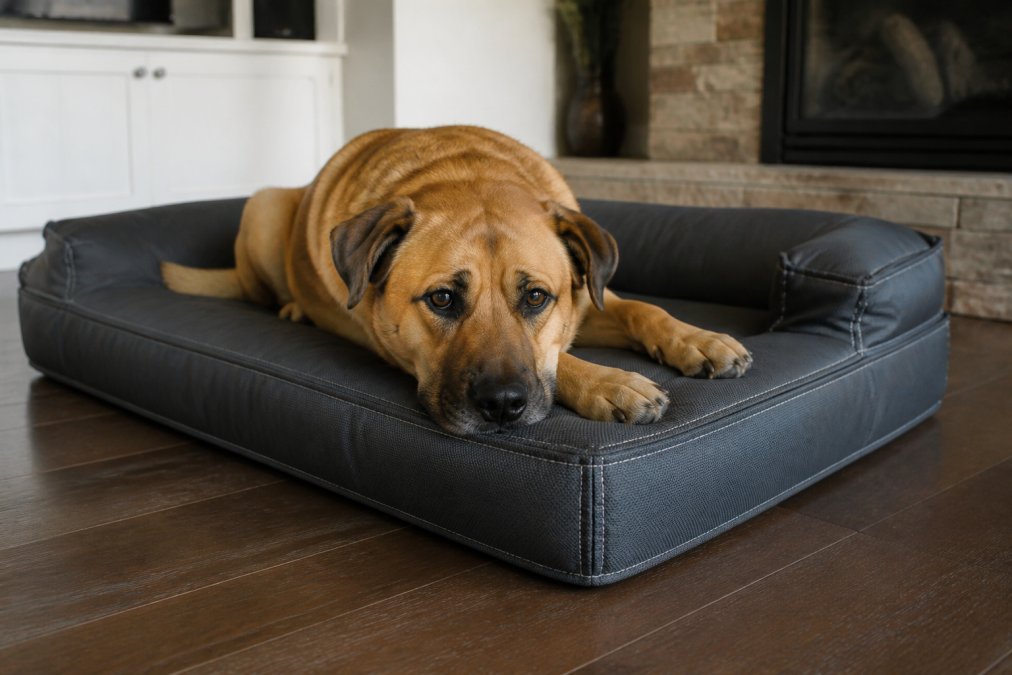
Denier Rating, Ballistic-Grade Fabric, and Rip-Stop Nylon
Denier is the weight of the yarn in the fabric, and it's the single best predictor of tear resistance. Higher denier means thicker, heavier yarn. Ballistic-grade fabric and rip-stop nylon both use high-denier weaves; rip-stop adds a grid pattern that stops a tear from running across the whole cover. For heavy chewers, look for ballistic-grade fabric with reinforced stitching at every stress point.
Reinforced Stitching and Heavy-Duty Zippers
The fabric rarely fails first. The stitching does.
- Double- or triple-stitched seams resist pulling at corners
- A heavy-duty zipper with a covered flap keeps teeth off the hardware
- Bound edges prevent fraying where a digger's nails catch
Pet Bed Size Guide: Measuring Nose to Tail
Measure your dog from the tip of the nose to the base of the tail while standing, then add 8 to 12 inches for a dog that curls and more for one that sprawls. A bed that's too small gets compressed at the edges, which breaks down filling and seams faster than any chewer could. This pet bed size guide matters more for durability than most buyers realize.
Sleeping Posture and Why It Changes the Math
Sleeping posture decides how much bed you actually need.
- Curled sleepers need less length but benefit from bolster support
- Sprawlers need a flat, oversized surface with no raised edges
- Stretchers need length plus a firm base that won't sag under pressure points
Support Materials That Keep Their Shape
Filling is where a bed either survives year two or turns into a flat mat. The cover gets the marketing attention, but the insert decides whether your dog is still supported after hundreds of nights of concentrated body weight.
Foam Density and Why the Number Matters
For memory foam, density is measured in pounds per cubic foot (lb/ft³), and it is the single best predictor of how long an insert holds its loft. A 3 lb/ft³ foam is light and cheap and compresses under a large dog within months. A 4 lb/ft³ foam is the common mid-grade for everyday pet beds. A 5 lb/ft³ foam is the top tier most often sold as orthopedic, and it is the grade that still rebounds after years of nightly loading.
Orthopedic Layering for Seniors and Joint Issues
A single slab of foam is the entry-level orthopedic build. The more durable orthopedic beds use a two-layer construction: a firm high-density base that resists bottoming out, topped with a softer comfort layer that relieves pressure at hips and elbows. The base carries the load; the top layer carries the joints. When the top layer compresses, the base is still doing its job, which is why layered inserts outlast single-density inserts of the same overall thickness.
Overstuffed Inserts and the Loft Trap
Overstuffed polyester and shredded-foam inserts feel plush on day one and lose their loft fastest. Shredded fill shifts, channels form under pressure points, and the bed develops flat spots within a few months. If you want the plush look without the collapse, choose a shredded-foam insert with a high-density base underneath, or skip shredded fill entirely for a solid high-density core.
Weight-Bearing Capacity: How to Test Structural Integrity
There is no standardized weight rating for pet beds, which is why a bed 'rated for large breeds' can still fail under a 120-pound dog. You can test structural integrity yourself before the dog ever lies down:
- The hand-press test. Press your palm firmly into the center of the insert. A high-density foam rebounds within a second or two. A low-density foam stays compressed or rebounds slowly.
- The edge test. Press down on the bed's edge. If the edge collapses easily, the bed will sag where your dog's weight concentrates, and seams will pull.
- The overnight test. After the first full night, check whether the insert has a visible body-shaped depression. A shallow, temporary impression is normal. A deep, persistent crater means the foam is under-dense for your dog's weight.
- The seam check. Run a finger along the seams after a week. Loose threads or stretched stitching at the corners signal the construction, not the fabric, is the weak point.
How to Clean Durable Pet Beds Without Breaking Them Down
Most 'worn out' beds were destroyed by the washer and dryer, not by the dog. Cleaning is where durable materials quietly lose the properties you paid for, so the care routine matters as much as the purchase.
What Heat and Detergent Actually Do to Durable Fabrics
Ballistic-grade and rip-stop nylon get much of their tear resistance from a tight weave and, in many cases, a polyurethane or DWR (durable water repellent) coating. Hot water and a hot dryer break down those coatings, which is why a bed that shed water in month one soaks through in month six. High heat also relaxes the weave, and a relaxed weave is a weaker weave.
Cover Care vs. Insert Care
The cover and the insert have different rules, and mixing them up is the most common way people ruin a good bed.
- Covers: Machine washable in most cases. Cold water, gentle cycle, mild detergent, air-dry. If the cover has a waterproof membrane or a coated backing, check the tag, some membranes degrade in a washing machine and are spot-clean only.
- Foam inserts: Never put a memory foam or high-density foam insert in a washing machine. Water saturates the foam, and a machine spin can tear the cell structure. Spot-clean with a damp cloth and a mild solution, then air-dry fully before the cover goes back on. A damp insert grows mildew and loses its rebound.
- Shredded-fill inserts: Spot-clean only. Water causes the fill to clump and channel, which is the beginning of the end for a shredded bed.
A Maintenance Schedule That Extends Bed Life
Durability is a routine, not a purchase. A simple schedule keeps a good bed in service far longer:
- Weekly: Shake out the bed and vacuum the cover to remove hair, dander, and grit. Grit acts like sandpaper inside the weave and accelerates wear at the seams.
- Every two to four weeks: Wash the cover per the tag instructions. More frequent washing is fine if your dog sheds heavily or has accidents.
- Monthly: Inspect seams, zippers, and the insert. Catch a loose seam early and it is a repair; catch it late and it is a replacement.
- Seasonally: Air the insert outdoors in shade (not direct sun, which degrades foam) to reduce odor and moisture.
Odor, Allergens, and Why Durability and Hypoallergenic Care Overlap
A bed that holds up structurally can still fail the household if it traps allergens. Dander, saliva, and dust mites accumulate in the weave and in the foam's open cells, and a bed that cannot be effectively cleaned becomes a reservoir. This is the angle most buying guides skip: durability and allergen control are the same problem.
Repairability, Replacement Parts, and Weight-Bearing Limits
The most durable bed is the one you can fix. Replaceable covers, sold separately from the insert, extend bedding longevity far beyond a sealed one-piece design. Check the weight-bearing capacity too: a bed rated for a small breed will compress under a large dog and fail at the seams. For multi-pet homes, a single elevated cot with a replaceable cover often outlasts three cheap beds.
| Destruction Style | Best Material | Key Feature | What to Avoid |
|---|---|---|---|
| Nester | High-denier rip-stop | Overstuffed bolster | Low-density fill |
| Digger | Ballistic-grade fabric | Reinforced top stitching | Loose covers |
| Chewer | Aircraft-grade weave | Recessed heavy-duty zipper | Exposed zippers |
| Leaker | Water-resistant shell | Removable washable cover | Non-removable inserts |
Frequently Asked Questions
What materials make a pet bed truly durable?
Look for ballistic-grade fabric, rip-stop nylon, or heavy canvas with a denier rating of 1000D or higher. Reinforced stitching at seams and corners prevents blowouts, and a heavy-duty zipper keeps covers from splitting. Water-resistant liners help with accidents. Together, these features determine how well a bed handles chewing, digging, and daily wear.
How can I tell if a pet bed is chew-proof?
No bed is truly indestructible. Beds labeled chew-resistant use tightly woven, high-denier fabric that resists punctures longer than standard polyester. Check for reinforced seams, hidden zippers, and stitching that does not pull apart. If your dog is a determined chewer, pair a chew-resistant bed with supervised use and rotate in appropriate chew toys to redirect the behavior.
Do orthopedic pet beds last longer than standard foam beds?
They often do, because higher-density memory foam resists flattening better than low-density filler. A density around 3 to 4 pounds per cubic foot holds its structure longer under a heavy dog. The cover quality still matters, though. An orthopedic insert inside a thin, tear-prone cover will fail early. Match a dense foam core with a durable, washable cover.
How often should you replace a durable pet bed?
Most quality beds last one to three years with regular cleaning and a waterproof liner. Replace sooner if the foam stays compressed after your dog gets up, the cover has tears exposing filling, or odors persist after washing. Seniors and heavy dogs put more stress on foam, so check support every few months. Replacement covers and inserts can extend the bed's life.
Choosing a bed that survives your dog's specific habits, not just one that looks tough in a photo, is the difference between a purchase that lasts years and one that lasts a month. Blanco's Pet Store curates bedding built for real wear, with replaceable covers, orthopedic support, and reinforced construction for every destruction style. Shop Now and find a bed matched to your dog, backed by a team that understands pets through every stage of their journey.