

Best Puzzle Toys for Anxious Cats: 5 Picks That Calm

Table of Contents
- Signs of Anxiety in Cats: Is Your Cat Stressed?
- Why Puzzle Toys Work: The Benefits of Food Puzzles for Cats
- How We Chose the Best Puzzle Toys for Anxious Cats
- Feature Comparison: Top Puzzle Toys for Anxious Cats
- 1. Cat Amazing Classic Puzzle: Best for Foraging Instincts
- 2. Nina Ottosson Buggin' Out Puzzle & Play: Best for Problem Solvers
- 3. PetSafe SlimCat Interactive Feeder: Best Budget Pick
- 4. Trixie 5-in-1 Activity Center: Best for Multi-Cat Homes
- How to Calm an Anxious Cat: A Simple Protocol
- Frequently Asked Questions
Last Updated: September 8, 2026
When a cat paces, hides, or overgrooms, the cause is often more than a passing mood. Anxiety in felines is a genuine behavioral health issue, and the right tools can make a measurable difference. For pet owners looking for the best puzzle toys for anxious cats, the goal is to redirect nervous energy into productive, instinct-driven activity. At Blanco's Pet Store, we offer curated enrichment tools that help restore a sense of control and calm for your companion.
Quick Picks:
- Best Overall: Cat Amazing Classic Puzzle, ideal balance of foraging stimulation and value
- Best for Problem Solvers: Nina Ottosson Buggin' Out Puzzle & Play, durable, adjustable challenge
- Best Budget Pick: PetSafe SlimCat Interactive Feeder, affordable, portion-controlled activity
Signs of Anxiety in Cats: Is Your Cat Stressed?
Common indicators of feline stress include excessive grooming, hiding, changes in appetite, and a sudden increase in vocalization. Destructive scratching or eliminating outside the litter box often signals distress rather than defiance.
Understanding these behaviors is the first step. Puzzle toys for anxious cats work best when introduced early, before stress becomes a deeply ingrained habit. If you notice pacing or compulsive behaviors, enrichment can redirect that energy into a healthier outlet.
The Anxiety-Enrichment Loop: Why Timing Matters
Anxious cats operate on a hyper-vigilant baseline. When cortisol is elevated, the brain's ability to process new challenges diminishes, so a puzzle that works for a calm cat can backfire for an anxious one (peer-reviewed research). The key is to pair puzzle introduction with a predictable behavioral protocol.
A common pattern among veterinary behaviorists is to use the 'Three-Phase Introduction' for anxious cats:
- Phase 1: Association (Days 1-3). Place the puzzle near the cat's safe zone (a bed, a quiet corner) without any food inside. Reward calm proximity with a high-value treat from your hand. The goal is to neutralize any novelty stress.
- Phase 2: Low-Stakes Success (Days 4-7). Place a single, high-value treat on top of the puzzle or in the easiest compartment. Let the cat win immediately. Repeat this until the cat approaches the puzzle without hesitation.
- Phase 3: Graduated Challenge (Week 2+). Only now should you hide treats inside. Start with the easiest setting and increase difficulty only after your cat completes the puzzle in under two minutes without signs of frustration (tail lashing, excessive vocalization, or walking away).
This protocol directly addresses the 'Frustration Threshold', the point at which a task becomes more stressful than stimulating. A cat that fails repeatedly will generalize that failure to the feeding area, making future attempts harder.
Distinguishing Anxiety from Medical Issues
Before assuming a behavioral cause, rule out medical conditions that mimic anxiety. Hyperthyroidism, dental pain, and urinary tract infections can all cause restlessness, hiding, or litter box avoidance (avma.org). If your cat's behavior changes suddenly, a veterinary exam is the first step. Puzzle toys are a complement to, not a substitute for, medical care.
When to Intervene vs. When to Let It Pass
Not every anxious behavior requires a puzzle. A cat that hides during a thunderstorm may need a quiet, enclosed space more than a cognitive challenge. Puzzle toys are most effective for chronic, low-grade anxiety, the kind that manifests as pacing, overgrooming, or attention-seeking. For acute panic episodes (e.g., fireworks), a puzzle is unlikely to help and may even add sensory overload. Save the puzzle for baseline stress, and use calming aids or a safe room for acute triggers.
Why Puzzle Toys Work: The Benefits of Food Puzzles for Cats
Food puzzles tap into natural foraging behavior, the core of how cats evolved to interact with their environment (peer-reviewed research). An indoor cat that receives meals in a bowl loses that hunting outlet entirely. Interactive feeders restore a version of that hunt, engaging the prey drive and providing crucial mental stimulation.
The benefits extend beyond simple distraction. Working for food engages problem-solving skills and paw-eye coordination, building confidence, the direct antidote to anxiety. A cat that successfully extracts a treat feels mastery, lowering stress hormones. Many owners find a 10-minute puzzle session tires out a nervous cat more than 30 minutes of chasing a laser pointer.
How We Chose the Best Puzzle Toys for Anxious Cats
Selecting the right toy requires understanding the "Frustration Threshold." A puzzle too difficult for a stressed cat will increase anxiety. We evaluated each option on difficulty progression, durability, and sensory engagement, ensuring a cat can achieve small wins quickly.
We prioritized adjustable difficulty levels, noise sensitivity (favoring quiet designs), and durable, non-toxic materials that hold up to supervised play.
Feature Comparison: Top Puzzle Toys for Anxious Cats
The table below summarizes the key differences between these top picks, helping you match a toy to your cat's specific personality and needs.
| Toy | Starting Price | Best For | Key Feature | Difficulty |
|---|---|---|---|---|
| Cat Amazing Classic | $15.95 | Foraging instincts | Three difficulty levels | Adjustable |
| Nina Ottosson Buggin' Out | $16.69 | Problem solvers | Sliding compartments | Adjustable |
| PetSafe SlimCat | $8.95 | Fast eaters | Rolling ball feeder | Simple |
| Trixie 5-in-1 Activity | $22.49 | Multi-cat homes | Five play modules | Varied |
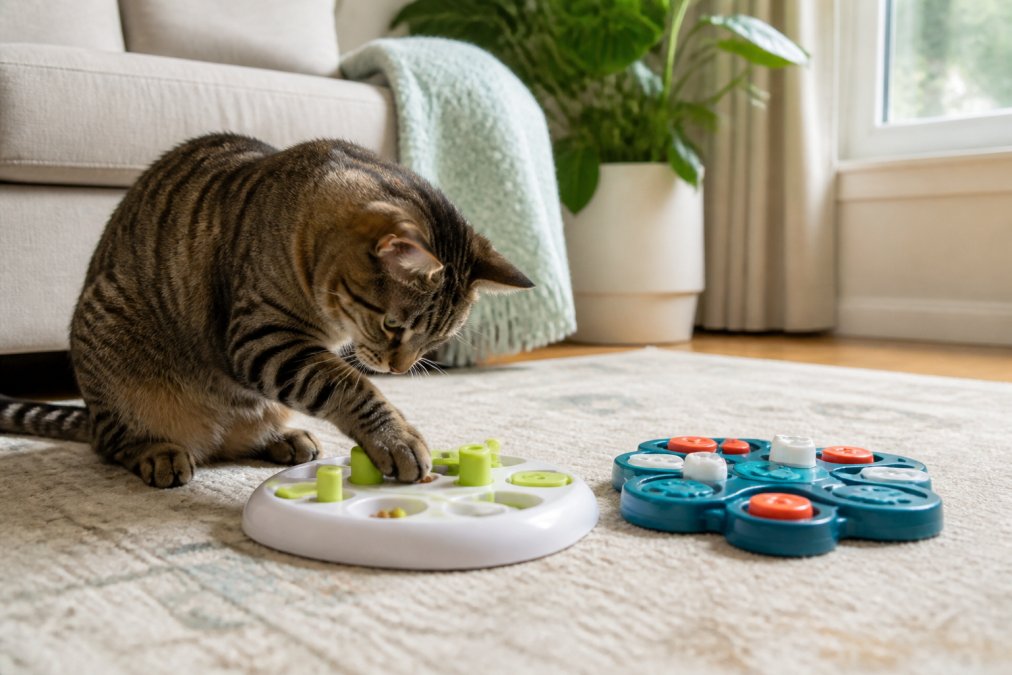
1. Cat Amazing Classic Puzzle: Best for Foraging Instincts
The Cat Amazing Classic Puzzle is a top pick for cats that need to dig, paw, and forage. This multi-level cardboard box mimics finding prey in hidden crevices, satisfying the hunting instinct. It comes with three difficulty levels, so you can start easy and gradually increase the challenge.
Its effectiveness for anxious cats lies in its simplicity. Pawing through flaps and slots provides immediate sensory engagement without complex problem-solving. It is affordable and easy to set up, making it a low-risk experiment. The cardboard may wear out with heavy use, but its price point makes replacement painless.
2. Nina Ottosson Buggin' Out Puzzle & Play: Best for Problem Solvers
For cats that breeze through simple puzzles, the Nina Ottosson Buggin' Out Puzzle & Play offers a more demanding challenge. Cats slide and flip plastic pieces to uncover treats, engaging problem-solving skills that static toys cannot. The non-slip base keeps the puzzle steady, preventing frustration.
The durable plastic stands up to enthusiastic pawing, and the difficulty is adjustable. It is ideal for food-motivated cats needing a mental distraction during stress, such as when you leave for work. It requires supervision, as some cats may chew the plastic, but for most it provides a rewarding challenge.
3. PetSafe SlimCat Interactive Feeder: Best Budget Pick
Not every anxious cat needs a complex puzzle board. The PetSafe SlimCat Interactive Feeder is a rolling ball that dispenses kibble as your cat bats it around. This encourages physical activity and slow feeding, valuable for cats that eat too quickly or carry nervous energy.
Adjustable openings control treat flow, and the unit is dishwasher-safe. At its price, it is an excellent entry-level option. The main downside is noise on hard floors, so use it on carpet for a sensitive cat.
4. Trixie 5-in-1 Activity Center: Best for Multi-Cat Homes
Households with multiple cats face a unique challenge: what calms one may bore another. The Trixie 5-in-1 Activity Center addresses this with five modules, globes, pegs, and tunnels, designed to stimulate all five senses. This variety keeps each cat engaged, suiting homes where one cat has anxiety and another is high-energy.
It occupies more floor space than single-puzzle toys, but earns that footprint by providing diverse stimulation in one unit. Non-slip rubber feet keep it stable during group play. For owners supporting multiple pets, this is a versatile single purchase available.
How to Calm an Anxious Cat: A Simple Protocol
Using puzzle toys effectively requires more than placing one on the floor. Establish a predictable routine where puzzle time happens at the same point each day, ideally before a stressful event like your departure. This creates a positive association and gives your cat a job to focus on.
Begin with short sessions of five to ten minutes, always ending on a success. If your cat completes the puzzle quickly, increase the difficulty. Consistent wins build the confidence that reduces separation anxiety. For senior cats with mobility issues, stick to stationary puzzles with large openings, as rolling toys may be frustrating to chase.
The Sound Sensitivity Factor: Choosing Quiet Puzzles
Anxious cats are often noise-averse. The sharp clatter of a plastic puzzle batted across a hard floor can trigger a startle response, undoing your calming effect.
Before you buy, consider the material and design:
- Cardboard or felt puzzles (e.g., Cat Amazing Classic) produce a soft rustle rather than a sharp crack. They are ideal for cats that flinch at sudden sounds.
- Silicone or rubber feeders are nearly silent when pawed. Look for options with suction cups or non-slip bases to prevent sliding.
- Plastic puzzles with sliding compartments (e.g., Nina Ottosson) are functional but can be loud. Place a rubber mat or towel underneath to dampen sound.
- Rolling feeders (e.g., PetSafe SlimCat) are the noisiest category. If your cat is sound-sensitive, avoid these on hardwood or tile; use them only on thick carpet.
A simple test: drop the puzzle from paw height onto your floor. If the sound makes you flinch, it will likely startle your cat. Choose accordingly.
Adapting the Protocol for Senior Cats and Mobility Limitations
Senior cats with arthritis or cognitive decline have different needs than anxious kittens. A puzzle requiring standing, stretching, or rapid paw movement can cause physical pain, misread as anxiety. For older cats, modify the protocol:
- Use flat, stationary puzzles where treats are visible and reachable with minimal movement. Avoid vertical or multi-tiered designs.
- Increase treat size so that pawing once or twice yields a reward. Small kibble that requires repeated precision is frustrating for a cat with reduced dexterity.
- Shorten sessions to 3-5 minutes. Cognitive fatigue sets in faster for senior cats. End the session while the cat is still engaged, not after it gives up.
- Watch for pain signals. If your cat lifts a paw and shakes it, or avoids using one side, stop the session. Pain, not anxiety, may be the issue.
The 'Calm Before the Storm' Routine
For separation anxiety, pair puzzle time with your departure cues. Ten minutes before you grab your keys, place the puzzle with a portion of your cat's daily meal inside. The cat learns to associate your leaving with a rewarding task rather than abandonment.
Over time, extend the difficulty so the task lasts longer than your departure routine (e.g., 15 minutes of puzzle time for a 5-minute goodbye). This shifts focus from your absence to the puzzle's completion.
Frequently Asked Questions
What is the best cat toy for an anxious cat?
The best puzzle toys for anxious cats engage their natural hunting instincts without causing frustration. Look for options like the Cat Amazing Classic or Nina Ottosson Buggin' Out that offer adjustable difficulty. Start with an easier setting to build confidence. A toy that dispenses treats slowly encourages focus and redirects nervous energy into a productive activity. The right match depends on your cat's personality, so observe how they interact and adjust the challenge level accordingly.
Are puzzle toys good for cats with separation anxiety?
Yes, puzzle toys can be a valuable tool for cats with separation anxiety. They provide cognitive enrichment and a positive distraction while you are away. A treat-dispensing toy like the PetSafe SlimCat can keep a cat occupied for 15-20 minutes, shifting their focus from your absence to the rewarding task of foraging. This helps reduce stress and creates a positive association with alone time. Always pair the toy with a consistent departure routine for the best results.
How do I introduce a puzzle toy to a shy or nervous cat?
Introduce the toy gradually in a quiet room. Start by placing a few high-value treats on top of or near the toy so your cat associates it with positive rewards. Let them eat from it without any required interaction for the first few sessions. Once they are comfortable, hide a treat just inside an easy opening. Use positive reinforcement with calm praise. Never force interaction. Patience is key; short, stress-free sessions build confidence over time.
Can food puzzles help with cat anxiety beyond just distraction?
Food puzzles do more than distract; they address the root of much feline anxiety by satisfying the prey drive. The act of working for food mimics natural foraging behavior, which releases calming endorphins in the brain. This mental stimulation reduces stress hormones and provides an outlet for frustrated hunting instincts. Regular puzzle sessions can lower overall anxiety levels, making your cat more resilient to triggers like loud noises or changes in routine.