

Best Mobility Aids for Senior Dogs: 2026 Guide

Table of Contents
- Quick Comparison: Top Mobility Aids for Senior Dogs
- Signs of Arthritis in Senior Dogs: When to Consider Mobility Support
- How to Use a Dog Lift Harness: Step-by-Step Guide
- Best Dog Ramps for SUVs and Home Access
- Wheelchairs and Carts for Hind-End Weakness
- Traction, Orthopedic Support, and Home Modifications
- Conclusion: Choosing the Best Mobility Aid for Your Senior Dog
- Frequently Asked Questions
Last Updated: September 18, 2026
Quick Comparison: Top Mobility Aids for Senior Dogs
The best mobility aids for senior dogs are lift harnesses, ramps, wheelchairs, and traction products matched to your dog's specific weakness. Mobility aids are devices that support aging or disabled dogs with standing, walking, and climbing.
| Aid | Best For | Typical Price | Key Feature |
|---|---|---|---|
| Lift harness | Full-body support | $89 | Front and rear handles |
| Dog ramp | Cars and furniture | $150-$199 | Non-slip surface |
| Wheelchair | Hind-end weakness | Custom quote | Custom fit |
| Support sling | Quick bathroom trips | $35 | Portable |
| Traction socks | Slippery floors | $20 | Rubberized soles |
Signs of Arthritis in Senior Dogs: When to Consider Mobility Support
The most common signs of arthritis in senior dogs are stiffness after rest, reluctance to climb stairs, and slowing down on walks. Arthritis management starts the moment you notice these changes, not when your dog stops walking.
Watch for these early signals:
- Lagging behind on familiar walks
- Hesitating before jumping onto the couch or into the car
- Licking or chewing at a specific joint
- Stiffness that eases after a few minutes of movement
- A change in gait, a hop, a sway, or a head bob that wasn't there before
- Reluctance to be touched on the hips, shoulders, or lower back
- Shifting weight off one leg when standing still
Arthritis vs. hind-end weakness vs. neurological decline
These three look similar from across the room but call for different responses.
- Arthritis is joint pain and inflammation. It typically worsens with cold, damp weather and after rest, and improves with gentle movement.
- Hind-end weakness often points to hip dysplasia, degenerative myelopathy, or a neurological impairment. The hallmark is a dog that drags its rear paws, knuckles over, or crosses its back legs, signs of nerve involvement rather than joint pain.
- Muscle atrophy shows up as a visibly narrower rear end or a sunken topline. It usually follows disuse, so the sooner you support movement, the more muscle you preserve.
Breed-specific risk factors
Body type shapes which joints fail first. Long-backed breeds such as dachshunds, corgis, and basset hounds carry a higher risk of intervertebral disc disease, so a harness that supports the chest and rear, not a neck-only collar, matters more for them. Heavy-set breeds such as Labradors, golden retrievers, and rottweilers load their hips and knees harder, making weight management the single highest-leverage intervention.
Weight: the intervention owners skip
Extra pounds load every joint, so weight distribution and joint health go hand in hand. Ask your vet about a weight target before adding equipment. A common benchmark is being able to feel the ribs without pressing hard and seeing a waist from above. Even a modest reduction in body condition score can meaningfully reduce strain on hips and knees.
When to call the vet vs. when to buy gear
- Call the vet first if you see dragging paws, knuckling, loss of bladder or bowel control, sudden collapse, or a single limb that is hot, swollen, or painful to touch. These are not gear problems.
- Buy gear while you wait if the issue is gradual stiffness, slipping on floors, or difficulty rising, a harness, traction, and a ramp are safe to add before a diagnosis.
- Ask about rehab for any dog with a confirmed diagnosis. A certified rehabilitation practitioner can design a home exercise plan, and many offer virtual consults if there's no clinic nearby.
How to Use a Dog Lift Harness: Step-by-Step Guide
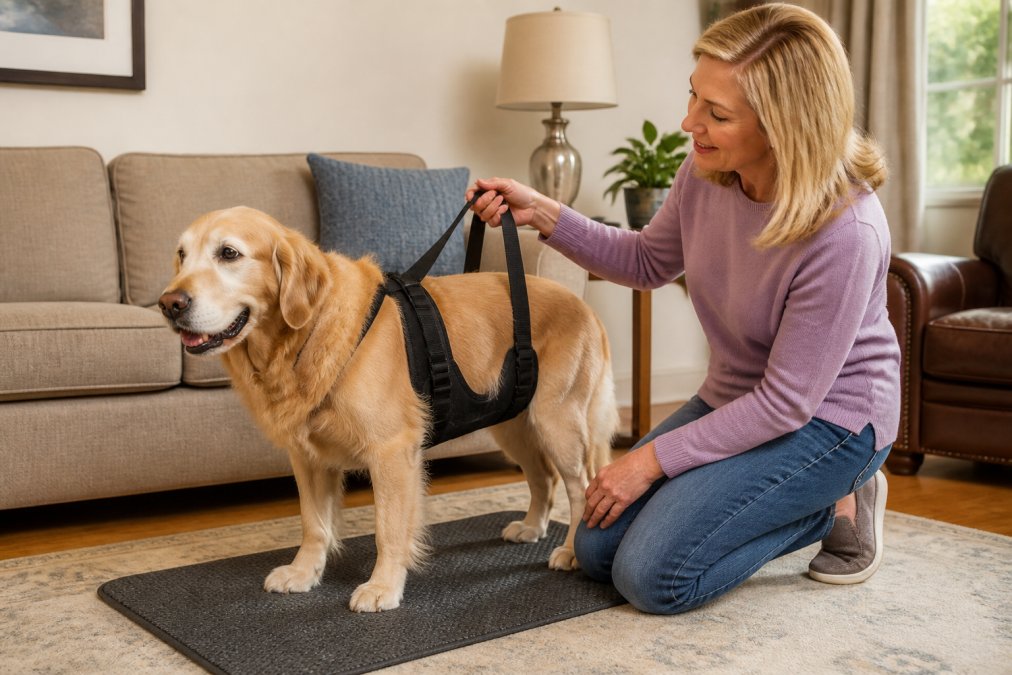
Learning how to use a dog lift harness takes about five minutes and prevents the back strain that comes from lifting a large dog by hand. A lifting harness distributes your dog's weight across the chest and hips instead of concentrating it under the belly.
What You'll Need:
- A full-body lift harness sized to your dog
- A non-slip mat or rug for footing
- Treats for positive reinforcement
Best Dog Ramps for SUVs and Home Access
The best dog ramps for SUVs have a high-traction surface, a low incline, and rubberized feet that grip the bumper. Ramps remove the jump that jars arthritic joints every time your dog gets in or out of the car.
Wheelchairs and Carts for Hind-End Weakness
A mobility cart is the right choice when a dog has lost the use of its hind legs but still has strong front legs and good energy. Carts restore independence for dogs with paralysis or severe hind-end weakness.
| Situation | Best Aid | Why |
|---|---|---|
| Occasional hind-leg weakness | Rear support sling | Portable, low cost |
| Consistent hind-end weakness | Wheelchair or cart | Restores independent movement |
| Joint instability | Custom brace | Structural joint support |
Traction, Orthopedic Support, and Home Modifications
Traction control and orthopedic support do more for a senior dog's daily comfort than any single piece of equipment. Slippery floors turn a minor weakness into a fall, and hard floors put pressure on sore hips all night.
Traction: the cheapest fix with the biggest payoff
Non-slip surfaces address the number-one cause of mobility decline in the home: the dog's own floor. Hardwood, tile, and laminate offer almost no grip, so a dog with weak hind legs splays out and loses confidence with every step.
Options, from least to most invasive:
- Traction socks with rubberized soles and adjustable velcro straps. Inexpensive, machine-washable, and effective on hardwood and tile. Some dogs resist them at first, so introduce them with treats over a few days and start with short sessions.
- Toe grips, small adhesive caps that fit over individual nails. Less bulky than socks and harder for a dog to paw off, but they need reapplication every few weeks.
- Runners and area rugs over slick hallways, kitchen work zones, and the path to the door your dog uses most. A continuous path matters more than total coverage; a dog will avoid a gap it can't cross.
- Interlocking foam or rubber mats for a dedicated resting and eating zone. Look for a textured top surface, not a smooth one.
Orthopedic bedding: what actually helps
An orthopedic memory foam bed relieves pressure on hips and shoulders by distributing weight across a wider surface instead of concentrating it on a single joint. Look for:
- A high-density foam core (not shredded fill, which compresses unevenly)
- A water-resistant liner for accidents that become more common with age
- Bolstered edges for head and neck support when a dog can no longer circle to settle
- A low-profile entry, a thick bed with a tall lip is a trip hazard for a dog that already struggles to rise
Low-cost home modifications
- Raised food and water bowls to reduce neck and shoulder strain
- A night light or motion-activated light so an older dog can find its way after dark
- A ramp or step set at the couch and bed instead of a single high jump
- Non-slip stair treads on any interior stairs, plus a baby gate to block access when you can't supervise
- A sling or harness hung by the door so you're not searching for it during a bathroom emergency
The behavioral side nobody talks about
Mobility loss is not just physical. A dog that slips once often starts refusing to walk on that floor at all, and a dog that can no longer climb onto the couch may stop asking for attention. Watch for:
- Reluctance to enter a room it used to love
- Increased clinginess or, conversely, withdrawal to a corner
- Whining at night, which can signal pain, anxiety, or both
- Accidents indoors after years of being reliable
Conclusion: Choosing the Best Mobility Aid for Your Senior Dog
The hardest part is not finding equipment. It is admitting your dog needs it, then matching the aid to the real problem instead of guessing.
Frequently Asked Questions
What are the best mobility aids for senior dogs with arthritis?
For arthritis, a combination of aids works best. Start with an orthopedic memory foam bed and non-slip traction socks or boots to reduce joint strain indoors. A supportive lift harness helps with standing and stairs, while a ramp prevents jumping into cars. For severe cases, a custom wheelchair can maintain mobility. Always consult your vet to tailor aids to your dog's specific joint health needs.
Is a ramp or stairs better for senior dogs?
Ramps are generally safer for senior dogs with joint issues because they provide a gradual incline that reduces impact on hips and knees. Stairs require more strength and balance, which can be difficult for dogs with hind-end weakness. However, if space is limited, low-profile stairs with non-slip surfaces can work for mild cases. Assess your dog's comfort and consult your vet.
Do vets recommend dog wheelchairs?
Yes, veterinarians often recommend wheelchairs for dogs with degenerative myelopathy, severe arthritis, or hind-limb paralysis. A properly fitted cart can improve quality of life by allowing exercise and preventing muscle atrophy. However, wheelchairs are not suitable for all conditions; a vet evaluation ensures the dog's front legs and overall health can handle the device. Custom fitting is essential for comfort.
How can I help my older dog whose back legs are collapsing?
If your dog's back legs are collapsing, a rear support leash or a full-body lift harness can provide immediate assistance for walking and bathroom breaks. For long-term support, consider a wheelchair. Also, make home modifications like non-slip rugs and ramps. Consult your vet to rule out treatable conditions and to get a rehabilitation plan that may include physical therapy.
What are the signs that my senior dog needs a mobility aid?
Watch for signs like difficulty standing up, reluctance to climb stairs, slipping on smooth floors, lagging behind on walks, or stiffness after rest. Other indicators include muscle atrophy in the hind legs and changes in gait. If you notice these, schedule a vet visit. Early intervention with mobility aids can slow progression and keep your dog comfortable.