

Best Mental Enrichment Toys for Dogs: 2026 Picks

Table of Contents
- Quick Comparison: Best Mental Enrichment Toys for Dogs
- Benefits of Puzzle Toys for Dogs
- 1. KONG Gyro: Best for Beginner Puzzle Dogs
- 2. Outward Hound Nina Ottosson Dog Brick Puzzle: Best Intermediate Challenge
- 3. Sniffiz SmellyMatty Snuffle Mat: Best for Anxious Dogs
- 4. West Paw Toppl: Best Durable Stuffable Toy
- 5. StarMark Bob-A-Lot: Best for Mealtime Enrichment
- 6. Flirt Pole V2 by Squishy Face Studio: Best for High-Energy Dogs
- DIY Dog Enrichment Ideas and How to Choose
- Frequently Asked Questions
Last Updated: September 13, 2026
Quick Comparison: Best Mental Enrichment Toys for Dogs
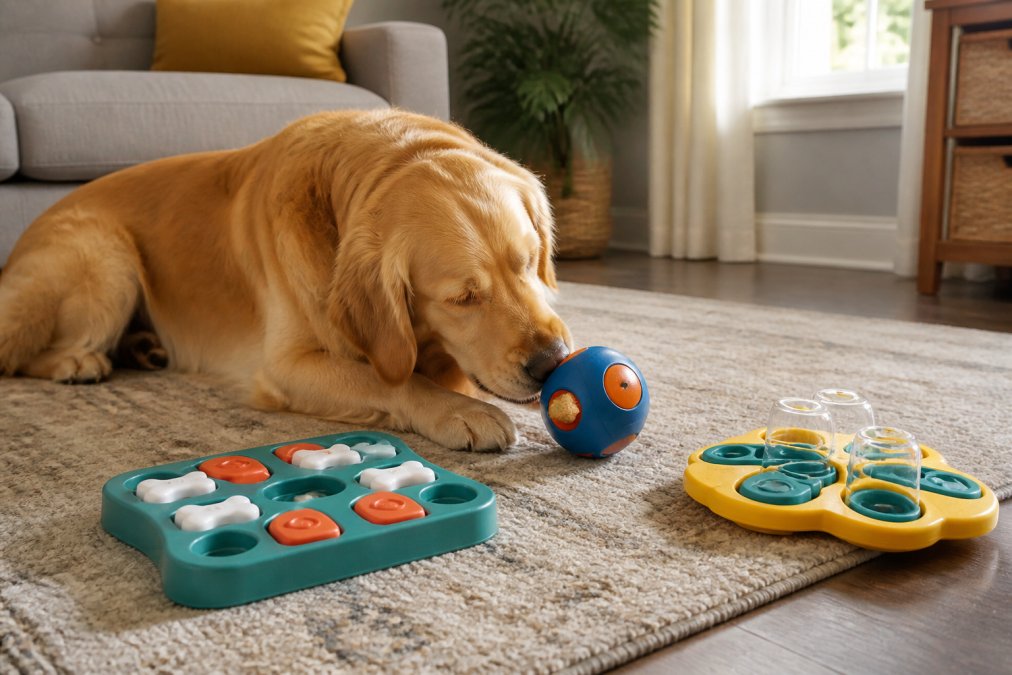
The best mental enrichment toys for dogs are treat-dispensing puzzles, snuffle mats, and stuffable chew toys that turn feeding and play into problem-solving work. This guide breaks down six proven options by difficulty, durability, and the behavioral need each one solves.
Mental enrichment is the practice of giving dogs structured challenges that engage their brains, not just their bodies. A bored dog will find its own entertainment, and that usually means chewed baseboards or barked-out afternoons.
Below, we'll match each toy to a specific dog: the beginner, the anxious one, the power chewer, the fast eater.
| Toy | Type | Difficulty | Best For | Price |
|---|---|---|---|---|
| KONG Gyro | Rolling dispenser | Beginner | First-time puzzle dogs | $12.99 |
| Nina Ottosson Dog Brick | Slider puzzle | Intermediate | Experienced problem-solvers | $19.99 |
| Sniffiz SmellyMatty | Snuffle mat | Beginner | Anxious dogs | $39.99 |
| West Paw Toppl | Stuffable toy | Adjustable | Power chewers | $16.95 |
| StarMark Bob-A-Lot | Meal dispenser | Adjustable | Fast eaters | $14.99 |
| Flirt Pole V2 | Interactive lure | Advanced | High-energy dogs | $34.95 |
Benefits of Puzzle Toys for Dogs
Puzzle toys convert a dog's natural foraging and problem-solving instincts into a structured activity. The payoff shows up in calmer behavior, slower eating, and less destructive chewing, but the mechanism matters, because it explains which toy to reach for when.
What Is Actually Happening
Foraging is a species-typical behavior. In the wild, a dog's day is largely spent searching, sniffing, and working for food. A bowl of kibble delivers the calories in ninety seconds and leaves the rest of that behavioral budget unspent. Puzzle toys redirect that budget into a task the dog is wired to perform. The result is not just a tired dog, it is a dog whose natural sequence (search, work, eat, rest) has been completed.
That is why mental stimulation often settles a dog faster than physical exercise alone. A hard run tires the body; a hard puzzle tires the body and satisfies the instinct.
Behavioral Benefits, Mapped to Specific Problems
Most guides list benefits in the abstract. Here is how enrichment actually maps to the problems owners bring to trainers.
Separation anxiety. A pre-departure snuffle session or a frozen stuffed toy gives the dog a focused task in the minutes before you leave. The goal is not to distract the dog forever, it is to change the emotional sequence around your exit from anticipation to engagement. A snuffle mat or a frozen Toppl is the right tool here; a plastic slider puzzle is not, because it requires supervision.
Resource guarding. Dogs that guard food bowls often guard them because the bowl is a high-value, short-duration event. Splitting a meal across a rolling dispenser or a snuffle mat spreads the food over time and lowers the intensity of any single moment. Work with a trainer if guarding is already established, enrichment is a supporting tool, not a fix.
Crate training. A stuffed, frozen toy given only inside the crate builds a positive association with the crate itself. The toy becomes the signal that good things happen here. Keep the toy novel by reserving it for crate time.
Impulse control. Toys that require waiting, a flirt pole held still until a release cue, a dispenser that only releases food when the dog is calm, turn enrichment into a training rep. This is where enrichment and obedience work overlap.
Destructive chewing. A dog that chews baseboards is usually under-stimulated, not malicious. A durable stuffable toy gives the chewing behavior a legal target. Match the durability to the chew style, not the dog's size.
The Daily Routine
A common pattern among trainers is to replace one meal per day with a puzzle or snuffle feed, and to add a short problem-solving session during the dog's natural energy dip, often mid-afternoon or early evening. Fifteen minutes of problem-solving can do more for a restless dog than thirty minutes of fetch, because it engages the brain rather than only the body (akc.org).
The American Kennel Club's guide to canine enrichment outlines how scent work, foraging, and puzzle play engage different parts of a dog's brain than physical exercise alone.
1. KONG Gyro: Best for Beginner Puzzle Dogs
The KONG Gyro is the easiest entry point into treat-dispensing play. It wobbles and spins unpredictably, and a center orb drops kibble as the dog nudges it around the floor.
Fill it with small treats or kibble, set it down, and most dogs figure it out within a few minutes. The motion is engaging without being frustrating, which matters for dogs that have never used a puzzle before. It cleans easily and holds up to moderate chewers, though heavy power chewers should look at the Toppl instead.
- Pros: Encourages natural foraging behavior, easy to fill and clean, gentle learning curve
- Cons: Not built for heavy-duty chewers
2. Outward Hound Nina Ottosson Dog Brick Puzzle: Best Intermediate Challenge
The Dog Brick Puzzle steps up the difficulty with flip boards and slide-out drawers. Dogs have to paw, nose, and problem-solve in sequence to reach hidden treats.
It's made from BPA, PVC, and phthalate-free materials (outwardhound.com). Supervision is required here. This is the toy that reliably reduces destructive behavior in dogs that have already mastered simple dispensers, and it's a strong fit for food-motivated dogs that need a real cognitive workout.
3. Sniffiz SmellyMatty Snuffle Mat: Best for Anxious Dogs
Snuffle mats mimic grass foraging by hiding kibble in layers of fabric. The Sniffiz SmellyMatty uses multiple texture levels and a non-slip base, and it's machine washable.
For anxious dogs, scent work is a calming activity. The act of rooting through fabric slows eating and redirects nervous energy into a focused task. This is also one of the best options for dogs with separation anxiety, since a pre-departure snuffle session gives them something to do before you leave. It takes up floor space, so plan for a dedicated spot.
- Pros: Promotes slow feeding, durable fabric, calming for anxious dogs
- Cons: Takes up significant floor space
4. West Paw Toppl: Best Durable Stuffable Toy
The West Paw Toppl is a stuffable toy built for tough chewers. Fill it with wet food, yogurt, or peanut butter, freeze it, and you have a long-lasting frozen enrichment challenge.
Its rounded inner base makes treat removal easy, and two Toppls interlock to raise the difficulty. It's dishwasher safe and made from non-toxic material. The catch: you need two units to unlock the full puzzle potential.
- Pros: Extremely durable, freezer-friendly, dishwasher safe
- Cons: Requires two units for maximum difficulty
5. StarMark Bob-A-Lot: Best for Mealtime Enrichment
The Bob-A-Lot turns dinner into a game. Adjustable openings at the top and bottom let you control how easily kibble falls out, and a weighted bottom makes it roll unpredictably.
It holds a full meal, which makes it a direct replacement for a food bowl. If your dog inhales meals in under a minute, this is the fix. It can be loud on hard floors, so a rug underneath helps. This is also a natural fit for integrating enrichment into a training schedule, since you can reward calm waiting with a roll.
- Pros: Customizable difficulty, holds a full portion, slows fast eaters
- Cons: Noisy on hard floors
6. Flirt Pole V2 by Squishy Face Studio: Best for High-Energy Dogs
The Flirt Pole V2 channels prey drive into structured play. A lure on a lightweight pole lets you direct the chase, and replaceable attachments keep the game fresh.
This is the tool for mental stimulation for high energy dogs that need both a physical and mental outlet. It's excellent for teaching impulse control through wait and get-it commands. The one requirement: you have to actively participate. It is not a solo toy.
- Pros: Great for impulse control training, intense exercise in small spaces
- Cons: Requires active human participation
DIY Dog Enrichment Ideas and How to Choose
DIY dog enrichment ideas are the budget-friendly complement to store-bought puzzles, and they let you test whether your dog actually enjoys foraging before you spend money on a manufactured toy. The mechanics matter more than the materials: you are hiding food, adding an obstacle, and rewarding persistence.
Five DIY Setups That Actually Work
- Muffin tin + tennis balls. Drop kibble into each cup of a standard 12-cup tin, cover each cup with a tennis ball, and set it down. The dog must nose or paw the balls aside to reach the food. This is a beginner setup, most dogs solve it in under five minutes.
- Cardboard box dig. Fill a shipping box with crumpled paper, scatter kibble through the layers, and let the dog shred and root. This is the closest DIY equivalent to a snuffle mat, and it doubles as a supervised destruction outlet for dogs that like to tear things apart.
- Towel roll. Lay a bath towel flat, scatter kibble down the center, roll it lengthwise, and tie it in a loose knot. As the dog's skill improves, tighten the knot. This is a cheap way to scale difficulty without buying anything.
- Frozen broth block. Freeze low-sodium broth with kibble inside a silicone mold or a paper cup. This is the DIY version of a stuffed, frozen Toppl and works well in warm weather.
- Scatter feed. Toss a portion of kibble across a lawn or a snuffle rug and let the dog hunt it down. This is the lowest-effort option and the easiest to fold into a daily routine.
How to Choose the Right Toy for Your Dog
Match the toy to three variables: size, chew style, and experience level.
Size. A toy that is too small is a choking hazard; one that is too large is frustrating. As a rule of thumb, the toy should be large enough that the dog cannot swallow it whole but small enough to pick up and carry comfortably.
Chew style. This is the variable most guides skip. A dog that gnaws steadily for an hour is a different buyer than a dog that destroys a plush toy in ninety seconds. For power chewers, prioritize solid, non-toxic rubber with no removable parts, the West Paw Toppl and the KONG Gyro fit here. For moderate chewers, plastic slider puzzles like the Nina Ottosson Dog Brick are fine under supervision. For gentle dogs, fabric snuffle mats and plush hide-and-seek toys hold up well.
Experience level. A dog that has never used a puzzle will give up on an intermediate slider puzzle and may start chewing it out of frustration. Start with a rolling dispenser, then graduate to sliders, then to multi-step puzzles.
Budget vs. Investment-Grade: A Cost-Per-Use View
A $12 rolling dispenser that gets used daily for a year costs pennies per session. A $40 snuffle mat that sits in a closet costs more per use than a $17 stuffable toy that gets frozen and refilled three times a week. The useful question is not the sticker price, it is how often the toy will actually come off the shelf.
A practical rule: buy one toy per difficulty tier, rotate them weekly, and only upgrade a tier when your dog consistently solves the current one in under two minutes. That keeps spending tied to your dog's actual skill progression rather than to a product list.
Rotate to Keep Engagement High
Keep three toys in active rotation and store the rest out of sight. Swap the active set weekly. Novelty is the active ingredient in enrichment, and a puzzle that sits on the floor every day stops being a puzzle and becomes furniture.
Frequently Asked Questions
What can I give my dog for mental stimulation?
Interactive puzzle toys, snuffle mats, treat-dispensing balls, and lick mats are all excellent options. These toys engage your dog's natural foraging and problem-solving instincts. For example, the KONG Gyro or Outward Hound Nina Ottosson Dog Brick Puzzle require your dog to nudge, flip, or slide parts to release treats. Even 15 minutes of mental enrichment can tire a dog as much as a long walk, making these toys a practical addition to any routine.
Do vets recommend cognitive dog toys?
Yes, many veterinarians recommend cognitive toys to support brain health and reduce boredom-related behaviors. Puzzle toys and enrichment activities can help maintain cognitive function, especially in senior dogs. They also provide outlets for natural behaviors like foraging and problem-solving. Always supervise your dog with new toys, and choose durable, non-toxic materials that match your dog's chewing style and size.
What are the signs my dog is bored with a brain game?
If your dog walks away, stares at you, or stops engaging after a few minutes, the puzzle may be too easy or too difficult. Other signs include destructive chewing, excessive barking, or pacing. Try increasing the difficulty by freezing treats inside a West Paw Toppl or using a snuffle mat with smaller kibble. Rotating toys weekly can also keep your dog interested and prevent boredom.
What is 15 minutes of mental stimulation for dogs?
Fifteen minutes of mental stimulation could be a short session with a puzzle toy, a sniff walk, or a training game. For instance, hiding treats in a snuffle mat or using a flirt pole for impulse-control practice. This amount of focused mental work can be as tiring as a 30-minute walk for many dogs. It's a great way to provide enrichment when you're short on time.
How do I choose the right enrichment toy for my dog's breed?
Consider your dog's size, chew intensity, and natural instincts. Herding breeds often enjoy puzzle toys that require problem-solving, while terriers may prefer digging or foraging toys like snuffle mats. For heavy chewers, durable rubber toys like the West Paw Toppl work well. Always match the toy's difficulty to your dog's experience and supervise initial play to ensure safety.
Boredom is the root of most destructive behavior, and the right toy solves it before it starts. Blanco's Pet Store curates engaging toys and training tools designed to keep dogs happy and healthy at every stage, from beginner puzzles to durable stuffable toys for power chewers. Shop Now at Blanco's Pet Store and turn everyday moments into lasting memories with your dog.