

Best Car Ramps for Large Senior Dogs: 2026 Guide

Table of Contents
- How to Choose a Car Ramp for a Large Senior Dog
- Heavy-Duty Dog Ramp for Cars: Weight Capacity and Stability
- Wide Dog Ramp for Large Dogs: Surface, Traction, and Side Rails
- Best Dog Ramp for SUV and Truck Access
- How to Train a Dog to Use a Ramp
- Ramp vs Stairs vs Harness: Which Is Right for Your Senior Dog
- Frequently Asked Questions
Last Updated: October 9, 2026
How to Choose a Car Ramp for a Large Senior Dog
Finding the best car ramps for large senior dogs starts with two numbers: your vehicle's load height and your dog's weight. Get those wrong and even a well-built ramp becomes a tipping hazard or an incline your dog refuses to climb.
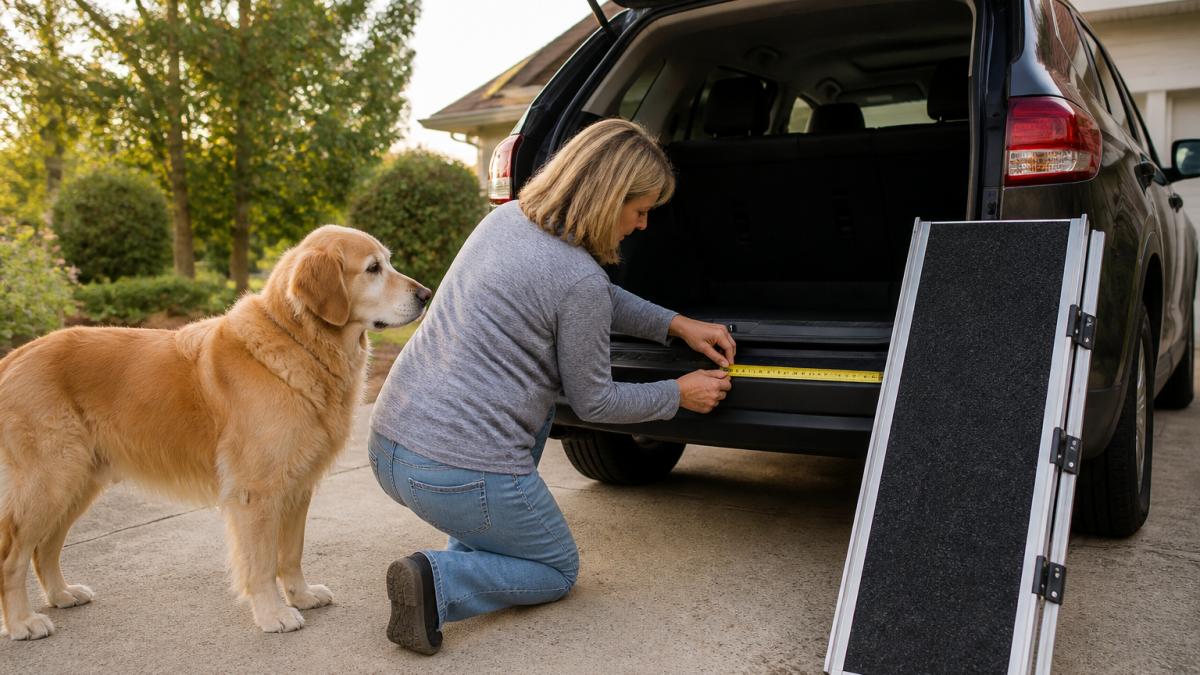
A car ramp for large senior dogs is a portable inclined surface that lets a dog walk from ground level into a vehicle instead of jumping, reducing impact on hips, knees, and spine.
Measure Your Vehicle Before You Buy
Load height is the vertical distance from the ground to the floor of your cargo area or the sill of your side door. Measure it with the vehicle parked on level ground and the tailgate fully open. That single number determines how long your ramp must be.
Door configuration matters just as much. A side door on a sedan or van gives you a lower sill but less clearance for a wide ramp. A truck bed or SUV cargo area sits higher and usually offers more room for a longer, wider ramp. Measure the opening width too, not just the height, so the ramp's frame actually fits.
Calculate a Safe Incline for Arthritic Joints
A safe incline for a senior dog with joint pain is generally shallower than what a healthy adult dog can manage. A common rule of thumb is to keep the slope gentle enough that the dog walks rather than climbs.
Here is the practical math. If your SUV's load height is 30 inches and you want a 1:4 ratio, you need a ramp at least 120 inches long. That is ten feet, longer than most owners expect. This is why telescoping and folding designs exist: they deliver the length you need without permanently occupying your cargo area.
Heavy-Duty Dog Ramp for Cars: Weight Capacity and Stability
A heavy-duty dog ramp for cars should be rated well above your dog's actual weight, not exactly at it. A senior dog that leans, pauses, or shifts sideways mid-climb puts dynamic load on the ramp, not just static weight.
Stability comes down to three things: the rated weight capacity, how the ramp contacts the ground, and how it contacts the vehicle. Rubber feet or non-slip base pads keep the bottom from sliding.
Flex is the quiet problem. A ramp that bows under a heavy dog feels unstable and can spook a nervous animal.
Wide Dog Ramp for Large Dogs: Surface, Traction, and Side Rails
A wide dog ramp for large dogs should give your dog enough room to walk without their paws hanging over the edge.
Traction is the difference between confidence and a slip. Look for a high-traction surface, such as a textured coating, rubberized mat, or closely spaced crossbars.
Side rails add a second layer of security. Raised edges give your dog a visual boundary and stop a paw from sliding off the side. For an injured or arthritic dog, that boundary often makes the difference between using the ramp and avoiding it.
| Feature | Why It Matters for a Senior Dog | What to Look For |
|---|---|---|
| Walking surface width | Prevents paws slipping off the edge | 15+ inches wide |
| Traction surface | Reduces slip risk on weak legs | Textured or rubberized coating |
| Side rails | Adds a visual boundary and safety edge | Raised edges along both sides |
| Weight capacity | Handles leaning and shifting loads | Rated above dog's weight |
| Base contact | Stops the ramp sliding on pavement | Rubber feet or non-slip pads |
| Vehicle contact | Stops the top kicking out | Lip or rest plate on the edge |
Best Dog Ramp for SUV and Truck Access
Vehicle fit is where most ramp purchases go wrong, and the reason is that "SUV compatible" and "truck compatible" mean almost nothing. What matters is the combination of load height, door or tailgate opening, and where the ramp will sit while the dog walks up it. Here is how to match a ramp to the vehicle you actually drive.
Cargo-area SUVs and crossovers
Most crossovers sit at a load height of roughly 24 to 30 inches, and full-size SUVs run a few inches higher. The tailgate opening is wide, which is good for a wide walking surface, but the cargo floor is often shallow front-to-back once the third row is up.
What to look for: a folding ramp with a rest plate that sits flat on the cargo lip rather than hooking deep inside, and a folded length short enough to lie flat behind the second row. Measure the depth from the tailgate opening to the back of the second-row seat, that is your storage budget.
Pickup truck beds
Truck beds are the hardest fit because the tailgate sits high, commonly 30 to 36 inches on stock trucks and higher on lifted ones, and the tailgate itself is a moving surface. A ramp resting on a tailgate that is not fully supported can shift under a large dog.
Dog Car Seat with Safety Belt and Secure Straps →
What to look for: a ramp long enough to hit a 1:4 slope from that height, a base that grips pavement rather than the tailgate edge, and side rails to keep the dog from stepping off the open side. If you regularly load from the bed, consider a ramp with an adjustable base so you can fine-tune the angle to the terrain.
Side doors on sedans, minivans, and SUVs
Side-door loading is underrated for senior dogs because the sill is usually lower than the cargo floor, which means a shorter, gentler ramp. The trade-off is clearance: the door opening is narrower than a tailgate, and the ramp has to angle in past the door frame and any running board.
What to look for: a narrower ramp that still gives at least 15 inches of walking surface, and a top lip thin enough to clear the door sill without catching. Measure the door opening width and the sill height separately, a ramp that fits the height may still be too wide for the opening.
Matching ramp type to vehicle
| Vehicle type | Typical load height | Best ramp style | Key fit check |
|---|---|---|---|
| Sedan / wagon | 20-24 in | Short folding or telescoping | Door opening width |
| Crossover SUV | 24-30 in | Folding, 60-72 in usable | Folded length vs. cargo depth |
| Full-size SUV | 28-34 in | Folding or telescoping, 72+ in | Rest plate depth on cargo lip |
| Minivan | 22-28 in | Folding, side-door friendly | Clearance past running board |
| Pickup truck | 30-36+ in | Long folding or telescoping | Base grip and side rails |
The three measurements to take before ordering
- Load height at the exact door or tailgate you will use most.
- Opening width at that same point, measured at the narrowest spot.
- Storage depth and height where the folded ramp will live, behind the seat, in the cargo area, or in the bed.
If a ramp clears all three, it will work. If it clears two, it will end up in the garage.
How to Train a Dog to Use a Ramp
Training a reluctant dog to use a ramp takes patience and short sessions, not force. Most senior dogs learn in a few days if you break the process into small steps and reward each one.
- Lay the ramp flat on the ground and let your dog sniff and walk across it with no incline.
- Raise one end a few inches and reward your dog for stepping onto the low end.
- Add treats along the surface so your dog walks the full length at a shallow angle.
- Set the ramp against the vehicle at the lowest usable height and guide your dog up with a treat.
- Practice the full-height climb with a helper steadying the ramp and a harness for support.
A support harness helps here. The Dog Lift Harness for Assistance ($33.99) lets you take some of your dog's weight while they learn the motion, and the Dog Hind Leg Support Harness ($25.99) gives extra stability for dogs with weak rear legs. Pair the ramp with a Waterproof Dog Car Seat Cover ($31.99) so a nervous first attempt does not mean a soaked back seat.

Ramp vs Stairs vs Harness: Which Is Right for Your Senior Dog
Ramps beat stairs for most large senior dogs because they remove the step-up motion that stresses hips and knees. Pet stairs still require a dog to lift each leg and shift weight, which is exactly what arthritis makes painful.
A harness is not a replacement for a ramp; it is a companion tool. A lift harness lets you support your dog's weight during the transition, which helps on the steepest part of the climb or on days when joints are stiff.
Here is how to decide:
- Mobile senior dog, higher vehicle: a wide, long ramp with high traction, plus a support harness for backup.
- Dog with weak rear legs: a ramp with side rails and a hind-leg support harness for the climb.
- Dog that refuses ramps entirely: a lift harness and a secure car seat, with ramp training over time.
Our Dog Car Seat with Safety Belt and Secure Straps ($55.99) keeps a dog secured once inside, and the Hammock Dog Seat Cover ($30.99) protects the seat during travel.

Frequently Asked Questions
How wide should a ramp be for a large dog?
Aim for at least 16 inches of usable walking surface for dogs over 70 pounds, and 20 inches or more for giant breeds. Width matters because senior dogs with joint pain or vision changes drift sideways when they walk. Side rails add another layer of security. If your dog is reluctant or has balance issues, a wide dog ramp for large dogs gives them room to pause without stepping off the edge.
What weight capacity should a car ramp have for a large senior dog?
Choose a ramp rated at least 50 pounds above your dog's current weight. A 150-pound capacity works for medium-large dogs, while 300-pound capacity suits Great Danes, Mastiffs, and similar breeds. Extra capacity also reduces flex, which spooks nervous dogs.
How long should a dog car ramp be for an SUV or truck?
Measure from the ground to your vehicle's cargo floor, then multiply by three to get a minimum ramp length for a gentle incline. A 30-inch cargo height needs roughly a 90-inch ramp. Shorter ramps create steep angles that strain shoulders and hips. For SUVs and trucks, a telescoping or folding ramp of 60 to 72 inches usually balances incline with storage space.
Are dog ramps safer than lifting a senior dog into a car?
For most senior dogs, yes. Lifting a large dog strains your back and can twist your dog's spine if they squirm. A ramp lets them move at their own pace and keeps all four paws supported. Pair a ramp with a dog lift harness for assistance if your dog needs extra support in the hindquarters. Always test the ramp on flat ground before using it at the car.
How do you get a reluctant dog to walk up a ramp?
Start with the ramp flat on the floor and reward any interaction, including sniffing or stepping on it. Use high-value treats and keep sessions under five minutes. Once your dog walks the full length on flat ground, raise one end by a few inches and repeat. Never push or pull your dog up the ramp. Patience over several days works better than forcing it in one session.
Choosing the right ramp for a large senior dog comes down to measurement, capacity, and traction, and getting it right protects joints that cannot afford another bad jump. Blanco's Pet Store curates mobility and travel gear built for exactly this stage of a dog's life, from support harnesses to secure car seats and waterproof covers. Shop Now and give your senior dog safer, easier car rides for every trip ahead.