

Are Automatic Pet Feeders Worth It for Busy Owners?

Last Updated: October 24, 2026
Quick Summary
Automatic pet feeders are worth it for busy owners who need consistent meal times and portion control for dry food, but they solve only scheduling, not care. They can't confirm your pet ate, fail during power outages, and mostly jam on wet food, so you still need a daily bowl check and a human backup for trips longer than a day.
- Weigh dispensed portions on a kitchen scale during the first week to check volume-based accuracy.
- Prefer a feeder with battery backup and a low-battery warning you will actually notice.
- Transition cats gradually over about a week, and restore the old bowl if a cat refuses food for 24 hours.
- Automate dry meals and serve wet food yourself, since wet food left out is a bacterial risk.
- For any trip longer than a day, line up a person to check the feeder and confirm your pet is eating.
Table of Contents
- Do Automatic Pet Feeders Actually Solve the Busy Owner's Problem?
- Automatic Pet Feeder Pros and Cons: What You Gain, What You Give Up
- Portion Control, Food Freshness, and the Reliability Questions Nobody Asks
- The Best Automatic Pet Feeder for Cats: Matching the Device to the Household
- How to Get a Cat Used to an Automatic Feeder Without a Hunger Strike
- Automatic Feeder for Wet Food: What Works and What Breaks
- When an Automatic Feeder Is Not a Substitute for Care
- Picking the Right Feeder at Blanco's Pet Store
- Frequently Asked Questions
Do Automatic Pet Feeders Actually Solve the Busy Owner's Problem?
Automatic pet feeders are devices that dispense measured portions of dry food on a schedule you set, without you being home. For busy owners, they solve one real problem well: the 6 a.m. wake-up call and the missed lunch on a 12-hour workday.
Below, we'll show what an automatic feeder does well, where it fails, and how to decide whether one belongs in your home, including the parts most buying guides skip: power outages, wet food, food guarding, and when a feeder is the wrong tool entirely.
Automatic Pet Feeder Pros and Cons: What You Gain, What You Give Up
The honest pros and cons of automatic pet feeders come down to consistency versus control: you gain a reliable schedule and freedom from early-morning wake-ups, and give up watching your pet eat, adjusting portions in real time, and knowing for certain the food dropped.
Where Automatic Feeders Win
- Consistency: Meals land at the same time every day, which matters for pets prone to food-seeking behavior.
- Portion control: A measured portion per meal supports weight management far better than a free-fed bowl.
- Freedom from the schedule: A workday that runs long, or a weekend trip, no longer means a missed meal.
Where They Fall Short
- Dry food only, mostly: Most mechanisms jam on large kibble or anything moist.
- No supervision: You can't confirm your pet ate, or that another pet didn't.
- Mechanical failure: Augers jam, batteries die, and hoppers clog.
Portion Control, Food Freshness, and the Reliability Questions Nobody Asks
Portion accuracy is where marketing claims and reality diverge most. A feeder that dispenses by volume rather than weight drifts over time, especially with unevenly settling kibble.
Food freshness is subtler: kibble in an open hopper absorbs moisture and goes stale faster than in a sealed bag.
The reliability question nobody asks: what happens when the power goes out or the batteries die? A feeder with no backup is a paperweight during an outage.
Build a failure plan before you need it
Treat the feeder like any appliance that can fail silently: assume it will, and decide in advance what you'll do. A workable plan has four parts.
- Power and battery backup. Prefer a unit that runs on batteries as its primary source, or one with a rechargeable battery plus a visible low-battery indicator. If it's AC-powered, confirm it has battery backup and fresh batteries, replace them on a schedule rather than waiting for a warning, and keep a spare set taped underneath so a swap takes seconds.
- Jam detection and alerts. Better units detect a blocked auger or chute and stop or push an app notification. If yours has no alert, you are the alert: check the chute and bowl daily and listen for the dispense cycle. A silent feeder is one you can't audit.
- A daily verification habit. Look at the bowl, not the app: apps report what the machine intended, the bowl reports what happened. A 10-second morning glance catches a jam, a knocked-over bowl, or a pet that isn't eating before it becomes a health problem.
- A human backup for absences. For any trip longer than a day, line up a neighbor, sitter, or family member who can check the feeder, refill water, and confirm the pet is eating. The feeder covers the meal; the person covers the failure.
Verify portions like you mean it
Volume-based dispensing drifts, so calibrate rather than trust. Run the smallest portion setting three times and weigh each on a kitchen scale; if weights vary by more than a few grams, it isn't precise enough for a weight-management diet without adjustment.
The Best Automatic Pet Feeder for Cats: Matching the Device to the Household
The best automatic pet feeder for cats matches your cat's eating style and your household's layout, not the feature list. A single-cat home with a healthy appetite needs far less machine than a three-cat house with a food guarder.
Here's how we'd match the device to the situation:
| Household situation | What matters most | What to avoid |
|---|---|---|
| One cat, dry food, healthy weight | Simple timed dispenser, easy to clean | Over-engineered app features you won't use |
| One cat, weight management | Accurate small portions, scale-checkable | Volume-based dispensing with no calibration |
| Multi-cat house with a guarder | Separation, or feeding in separate rooms | A single shared feeder |
| Senior cat with mobility limits | Low bowl height, easy access | Tall hoppers the cat must reach into |
| Cat that knocks things over | Weighted, stable base | Light plastic units on slick floors |
For a straightforward single-cat setup, a battery-powered timed dispenser is the sensible starting point. Our Timed Pet Feeder is a plastic, battery-powered unit built for cats and dogs, priced at $64.99, and it covers the core job without app clutter.

How to Get a Cat Used to an Automatic Feeder Without a Hunger Strike
Cats accept an automatic feeder through gradual transition, not a swap.
Here's the transition we recommend:
- Place the feeder next to the current bowl, unplugged and empty. Let your cat investigate it for two or three days.
- Feed from the feeder with the lid open for a few days, so food still comes from a familiar place.
- Run one scheduled meal per day from the feeder while keeping the other meals in the old bowl.
- Shift the remaining meals over one at a time, over about a week.
- Watch the first full week closely. If your cat stops eating for more than a day, go back a step.
Watch out: a cat that refuses the feeder for more than 24 hours needs the old bowl back immediately. Cats can develop serious health problems from not eating, and no feeding schedule is worth that risk.
Automatic Feeder for Wet Food: What Works and What Breaks
Wet food is where most automatic feeders fail, and the reason is simple: wet food spoils. A device that leaves it sitting out for hours creates a food-safety problem, not a convenience.
If your pet eats wet food, the realistic options are a compartment-style feeder that opens one sealed section at a time, or not automating that meal. For most households, automate dry meals and serve wet food yourself.
The three designs that handle wet food
- Rotating compartment feeders. A carousel of sealed compartments rotates to expose one serving at a time. Each portion stays covered until its scheduled opening, but they hold only a few meals and the compartments must be washed after every use.
- Ice-pack cooled units. A tray or compartment over a removable ice pack slows spoilage. These buy hours, not days, and the ice pack must be frozen and swapped on a schedule, which defeats the purpose if you're away.
- Pump or auger units marketed for wet food. The least reliable: wet food is heavy and sticky and clogs pumps and augers far more readily than kibble. Treat any "wet food compatible" pump feeder as needing daily inspection.
The food-safety limit
Wet food left at room temperature is a bacterial-growth risk, and the safe window is hours, not a full day. No consumer feeder changes that math. If you wouldn't leave it in a bowl on the counter that long, don't let a machine do it either: automate wet meals only when the feeder keeps the portion sealed or cooled until close to serving time, and serve the rest yourself.
Cleaning is part of the design decision
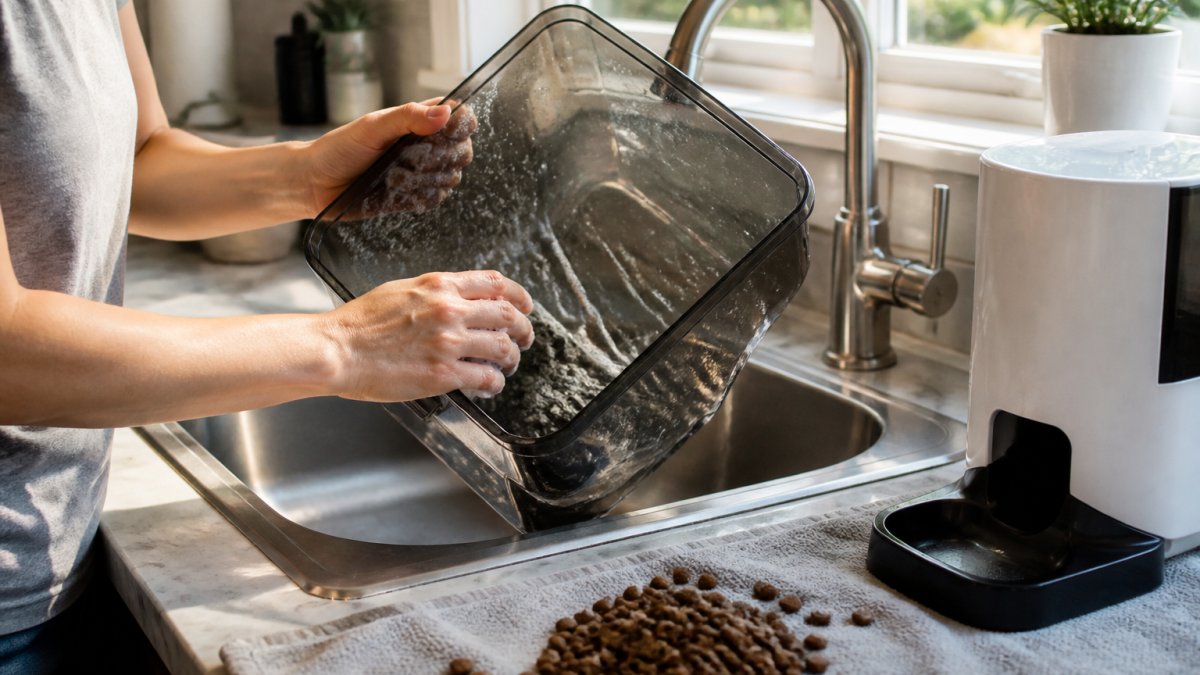
Wet-food feeders need washing after every serving, and food-contact parts, compartments, trays, lids, must be removable and dishwasher-safe or easy to hand-wash. A feeder that's hard to disassemble goes unwashed, and an unwashed wet-food feeder is a health hazard. Before buying, check that every food-contact part lifts out without tools.
If you want a feeder and water dispenser in one unit for dry food, our feeder and water dispenser option at $17.99 lets you choose a food bowl or a water dispenser, and it suits both cats and dogs. Just check which option you're selecting before ordering, since they're separate choices rather than a set.

When an Automatic Feeder Is Not a Substitute for Care
An automatic feeder is a scheduling tool, not a caretaker. If you're weighing care options for an older pet, see our Chewy vs Petco comparison for senior pets.
The clearest rule we can give you: if you're relying on the feeder because you're away more than a day, you need a person checking in, not a better machine. A feeder handles meals.
Picking the Right Feeder at Blanco's Pet Store
Start with the job, not the feature list. Ask three questions: Does your pet eat dry food? Is your household single-pet or multi-pet?
If the answers point to a simple timed dispenser, our Timed Pet Feeder at $64.99 is the straightforward pick. If you want food and water together, our feeding station with a water bottle at $16.99 keeps dry food and drinking water side by side, with a lidded hopper and a food-level window so you can see when it needs a refill.

The real challenge with automatic feeders isn't finding one that works, it's matching the device to your pet's eating habits, your household layout, and how often you're genuinely away.
If you're ready to sort out feeding without the guesswork, Blanco's Pet Store carries carefully selected feeding gear for cats and dogs, from simple timed dispensers to combined feeding stations.
Frequently Asked Questions
How do I feed my cat wet food while I'm away?
Most automatic pet feeders are built for dry kibble, not wet food. Wet food left in a hopper or dispensing mechanism spoils quickly and can clog the device, so the safer approach is to serve wet meals when you are home and let a timed feeder handle dry food during the workday. If you are gone overnight, arrange a sitter or neighbor to deliver the wet meal rather than leaving it sitting out. Check any feeder's listing carefully, because wet food compatibility is rarely confirmed even when a device looks like it could handle it.
How do you get a cat used to an automatic feeder?
Start by placing the feeder next to your cat's current bowl and running it empty for a day or two so the sound becomes familiar. Then load a small portion of their regular kibble and let the feeder dispense at the normal meal time while you stay nearby. Most cats adjust within a week or two. If your cat is nervous, hand-feed a few pieces beside the device and never force them to approach it. Keep the old bowl nearby at first, then remove it once your cat reliably eats from the feeder.
Can an automatic feeder replace a pet sitter?
No. An automatic pet feeder handles scheduled dry meals and portion control, but it cannot check for illness, refill water, clean bowls, or respond to a jam or power failure. For a long workday, a feeder is a reasonable convenience. For overnight trips or weekends away, pair it with a sitter or a trusted neighbor who can verify your pet is eating and behaving normally. Treat the feeder as a backup for routine meals, not as supervision.
Are automatic feeders reliable for dogs?
Reliability depends on the dispensing mechanism and how your dog behaves around it. Kibble size matters: pieces that are too large or too small can jam the auger or hopper. Battery-powered models need fresh batteries, and a determined dog may knock over a lightweight unit. Look for a feeder with a stable base and a hopper sized for your dog's kibble, and test it for a few days while you are home before relying on it during a workday. Always keep a manual backup plan for outages.
What should I look for when buying an automatic pet feeder?
Prioritize four things: a dispensing mechanism that matches your kibble size, portion control that lets you set measured meals, a stable base your pet cannot easily knock over, and a power source you can trust, whether battery or plug-in with a backup. If you have multiple pets, consider whether the feeder can be placed where one animal cannot guard it. Confirm the food capacity against your pet's daily intake, and check the listing for cleaning instructions, since food residue builds up over time.
